
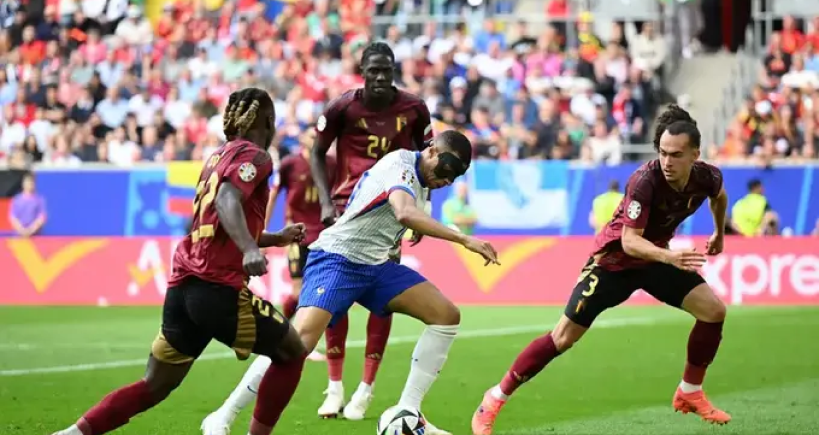
A remake of the Euro match two months ago: where to watch the France - Belgium Game?
Finding positive expected value is the foundation of every long-term betting strategy!
Expected value (EV) is the single number that separates bettors who profit over time from those who slowly hand their bankroll to the bookmaker. It does not promise that any one bet wins — it tells you whether a bet is worth making at all.
Most people bet on outcomes they think are likely. Profitable bettors do something different: they bet only when the price on offer is higher than the outcome deserves. That gap between a fair price and the bookmaker's price is your edge, and EV is how you measure it.
What expected value means
Expected value is the average result of a bet if you could repeat it thousands of times. A positive-EV bet returns a profit on average; a negative-EV bet loses on average, no matter how it feels in the moment. The formula is simple:
EV = (win probability × profit) − (loss probability × stake)
The hard part is never the arithmetic. It is producing an honest win-probability estimate that is better than the bookmaker's — because the odds you see already contain their estimate, plus a margin.
Turning odds into implied probability
Before you can judge a price, you have to read it as a probability. For decimal odds the conversion is one division:
Implied probability = 1 ÷ decimal odds
So odds of 2.00 imply a 50% chance, 1.50 implies 66.7%, and 4.00 implies 25%. Add up the implied probabilities of every outcome in a market and you will get a number above 100% — that surplus is the bookmaker's margin, often called the overround or vig.
| Decimal odds | Implied probability | Break-even win rate |
|---|---|---|
| 1.50 | 66.7% | 66.7% |
| 2.00 | 50.0% | 50.0% |
| 2.50 | 40.0% | 40.0% |
| 3.00 | 33.3% | 33.3% |
| 4.00 | 25.0% | 25.0% |
Estimating a fair line
Your edge lives in the difference between your probability estimate and the implied one. There are three practical ways to build that estimate:
- Remove the margin from a sharp book. Books like Pinnacle run on thin margins, so their no-vig price is a strong baseline for the true probability.
- Build your own model. Even a simple model using recent form, schedule and home advantage can beat soft lines in smaller markets.
- Use closing odds as truth. The price just before kick-off is the market's most accurate estimate — useful for grading how good your earlier number was.
A worked example
Say a bookmaker offers 2.10 on a team you have assessed at a true 52% chance to win. The implied probability of 2.10 is 47.6%, so your estimate says the price is too generous. Plug it into the formula on a $100 stake:
- Profit if it wins: $110, with probability 0.52 → +$57.20
- Loss if it loses: $100, with probability 0.48 → −$48.00
- EV = +$9.20 per $100 staked, an edge of 9.2%
That is a clear bet — provided your 52% estimate is genuinely sound. The entire method rests on the quality of that number, which is why honest probability estimation matters far more than the formula itself.
Proving your edge with closing line value
EV depends on an estimate, and estimates can be wrong. Closing line value (CLV) is the reality check: it measures whether the odds you took were better than the final odds before the event started. If you consistently beat the closing line, you are finding value before the market corrects — and that is the strongest evidence that your edge is real rather than luck.
Track CLV on every bet. Over a few hundred wagers it tells you more about your skill than your win-loss record ever will.
Common mistakes that kill your edge
- Estimating probability from the same odds you are judging. If your number just echoes the bookmaker, you have no edge by definition.
- Ignoring the margin. A bet that looks like value often disappears once you strip out the overround.
- Betting too big. A real edge still loses often; flat or fractional-Kelly staking keeps you solvent through the variance.
- Not line shopping. Taking 2.05 when 2.15 is available elsewhere quietly converts winning bets into losing ones.
- EV tells you whether a bet is worth making, not whether it will win.
- Convert odds to implied probability, then compare against your own estimate.
- An honest probability estimate is the whole game — the formula is the easy part.
- Use closing line value to confirm your edge is real over time.
