
Value betting: where the price is wrong

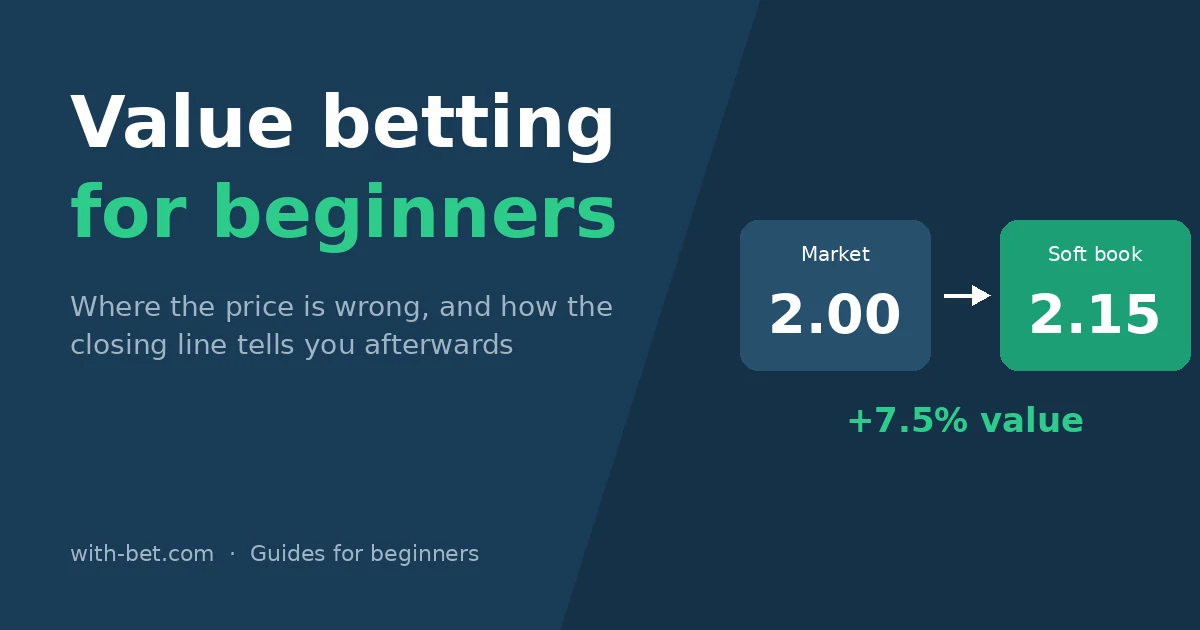
A value bet is a bet at odds higher than the outcome's real chance deserves. One result will not tell you whether it was one. Hundreds will, if you measure them against the closing line at a sharp bookmaker.
What a value bet is
Every price is a probability upside down. Odds of 2.00 mean a 50% chance: 1 divided by 2.00. Odds of 2.10 mean 47.6%. That percentage has a name, implied probability, and the odds converter shows it for any price in decimal, fractional or American form.
Now suppose the real chance is 50% and a bookmaker offers 2.10. The price is wrong by 2.4 points, in your favour. That is a value bet.
How much is it worth? Multiply the real chance by the odds and subtract one: 0.50 × 2.10 − 1 = 0.05, a 5% edge. Bet it many times and you keep about €5 of every €100 you stake. Betting forums call this expected value, EV for short, and a bet with a positive one is +EV. Do the same sum at 1.90 and you get −5%. That bet loses over time no matter how often it wins this month.
Of course nobody knows the real chance. Value betting is guessing it better than the price does, and the odd part is that the market will tell you afterwards whether you guessed well. The next sections are about how it does that.
A value bet can lose. What makes it a value bet is the price, not the result.
Where the "real" price comes from
Bookmakers come in two kinds. A sharp bookmaker takes big bets from winning customers and keeps its prices close to the truth, earning a small margin on volume. A soft bookmaker limits winners, charges a bigger margin, and lets its prices drift for hours. Value lives at the soft ones. It is measured at the sharp ones.
Why the sharp ones? Because their price moves every time money arrives, and by kick-off it has swallowed the injuries, the team news and the bets of people who know more than you. It is about as close to the real chance as anyone gets. That last price before the start is the closing line, and the bookmaker almost everyone uses for it is Pinnacle.
So Pinnacle's closing price stands in for the truth, and every earlier price is judged against it. Took 2.10, closed at 1.95? Value bet, whatever happened in the match. Took 2.10, closed at 2.25? Not a value bet, even if it won.
You do not need a Pinnacle account for any of this. Odds comparison sites keep the price history of finished matches, bookmaker by bookmaker, and the last Pinnacle figure before kick-off is the one you want. No Pinnacle for your sport? Take the market average instead.
Closing line value, worked out
Closing line value, CLV, is the gap between your price and the closing price, as a share of the closing price:
CLV = (your odds ÷ closing odds) − 1
[IMAGE: clv-worked-example.webp | Alt: Diagram showing a bet taken at 2.10 that closes at 1.95 for positive closing line value and one that closes at 2.25 for negative closing line value | Caption: The same bet at 2.10, two closing prices, two answers.]
- Took 2.10, closed 1.95: 2.10 ÷ 1.95 − 1 = 7.7%. Positive, and large.
- Took 2.10, closed 2.25: 2.10 ÷ 2.25 − 1 = −6.7%. Negative.
Average that number over a season and you have your closing line value. Keep it above zero for a few hundred bets and you have an edge, even if the profit column has not caught up.
One refinement, because you will meet it. A closing price still carries the bookmaker's margin. If both sides of a match close at 1.95, the two implied chances add up to 102.6%; the spare 2.6% is the margin. Strip it out and the fair closing odds are 2.00 each side, which is where the converter's implied-probability column earns its keep. Against 2.00 rather than 1.95, that 2.10 is worth 5%, not 7.7%.
For a beginner the simple figure is fine. At one bookmaker it overstates every bet by roughly the same amount, so the comparisons still hold. Switch to the margin-free version when you start comparing tipsters, or bookmakers with each other.
Why CLV is a better scorecard than profit
Results mislead for a long time. At odds around 2.00, a real 3% edge needs thousands of bets before the profit is more than luck could explain; one widely quoted analysis puts the sample size at two to three thousand for results alone, and at a few hundred for the same edge measured by closing line value.
The two can also flatly disagree. One tipster on Bet2Invest, which prints closing line value beside every pick, showed 1,731 bets on stakes of varying size, a profit of 87 units and a 4.86% return on turnover. Beside those numbers: a closing line value of −0.34%.
So the bets paid, and the market moved against them on average. Read by profit, a good run. Read by closing line value, a record with no measurable edge behind it. Which reading is right? For the next thousand bets, probably the second. The tipster platforms comparison shows where each site puts that number.
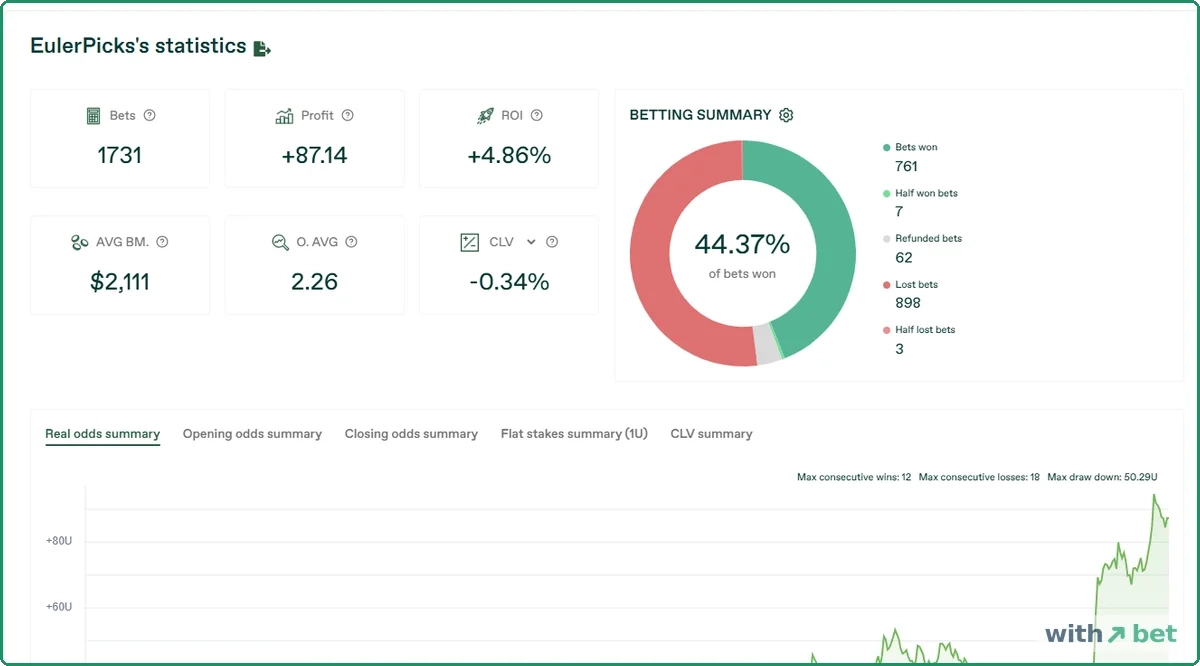
Profit shows what happened. Closing line value shows whether the price was right.
How value bets are found
Almost nobody works the probabilities out from scratch. The usual way is to compare prices: find a bookmaker whose odds sit above the sharp price, or above the market average, and bet the gap.
Three kinds of tool do that comparison for you. Odds comparison sites lay every bookmaker's price on one line, so the outlier is visible at a glance; the odds comparison category reviews them. Value-bet scanners repeat the comparison every few seconds and list the gaps as percentages, the way arbitrage scanners list surebets. Most surebet scanners have a value-bet tab, and RebelBetting is built around value bets first, with the percentage capped on its free trial. Tipster platforms that print CLV do the checking after the fact, on someone else's picks.
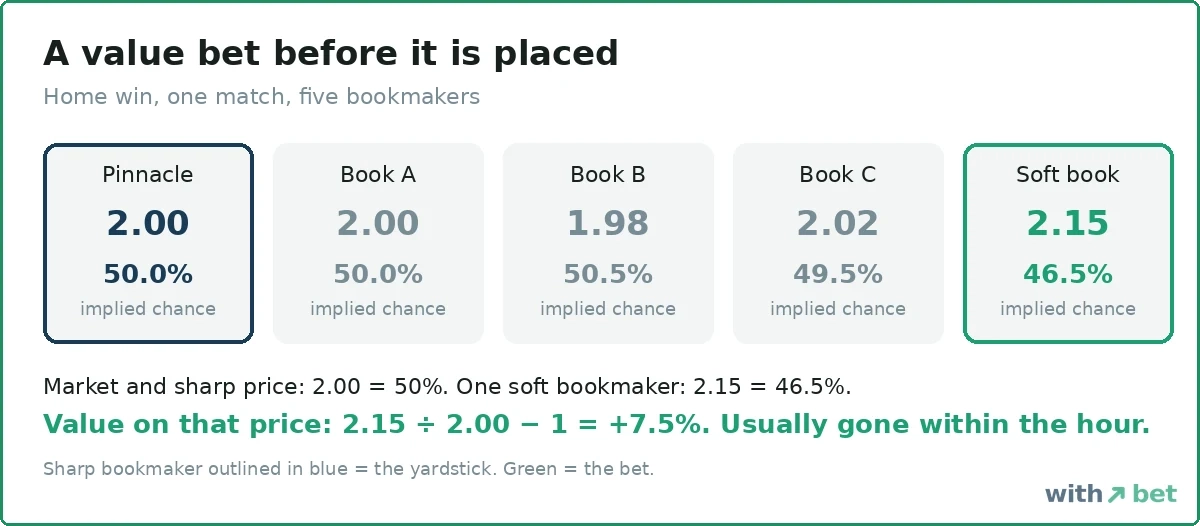
Whichever tool, the bet looks the same. A home win sits at 2.00 across most of the market, 2.00 at Pinnacle after its margin, and one soft bookmaker still shows 2.15. Implied probability 46.5% against the market's 50%. That is 7.5% of value on that price, and it will usually be gone within the hour.
What a 3% edge pays
Value betting is a turnover business, like arbitrage but with swings. At a 3% edge, €1,000 of stakes returns about €30 over time, €10,000 about €300. To earn €500 a month you place roughly €17,000 of bets, and "over time" can mean months.
The swings are the part beginners underestimate. Value bets are single bets that lose more often than they win at odds above 2.00, so a losing run of ten or twelve is nothing unusual.
Records measure those swings in units, one unit being your standard stake; level stakes means the same unit on every bet. The Bet2Invest profile above, with no measurable edge by closing line value, still recorded a maximum drawdown of 50 units, meaning that at one point the record sat 50 stakes below its previous peak. A record with a genuine 3% edge produces runs of the same size, because the edge is small and the odds are the same.
Put money on that. At €20 a unit, €1,000 disappears and you have to keep betting through it. The Kelly guide is where to size the unit so that a run like that does not end the experiment.
A record with no edge held a fifty-unit losing stretch. A record with an edge will hold one too. Choose a stake you can carry through it.
The catch: bookmakers limit value bettors
A bookmaker that keeps offering prices above the sharp market to the same customer is losing money to that customer, and its terms let it stop. Value bettors get limited about as fast as arbitrage bettors, because the pattern is just as visible: bets only at soft prices, often just after a line moves, mostly at one book. The scanners' own help pages tell you how to delay it, with round stakes and ordinary bets in between. None of them promises more than delay.
Two things follow. A value-betting record built at one soft bookmaker ends when that account is limited. And the sharper the bookmaker, the smaller the value; Pinnacle rarely offers a price that beats its own closing line. That is the whole reason the edge is found at soft books and measured at the sharp one.
Value betting and arbitrage
Same tools, different maths. An arbitrage bet covers every outcome at two bookmakers and locks in a small profit with no swings. A value bet backs one outcome at a price the market says is too high, and accepts the swings for a larger edge. Arbitrage pays for turnover; value betting pays for turnover and patience.
Beginners often start with arbitrage, because a surebet is easy to check with a calculator and pays whichever side wins, and move to value betting once they can read a closing line and sit through a losing run. Both routes cost accounts at the same speed. The difference is the swings. Arbitrage betting for beginners covers the first half of that route.
Using the tools, step by step
Five things you will do, in the order you will do them.
1. Turn a price into a chance. Open the odds converter, type the odds into the decimal field, and read the "implied probability" line: 2.10 shows 47.6%. Bookmaker shows 11/10 or +110 instead? Type that into the fractional or American field and the converter fills the rest.
2. Find a candidate. On an odds comparison site, open a match and look along the row for the market you want, say the home win. Most prices sit close together. One may stand above the rest. Compare it with the Pinnacle price in the same row, or with the average if the site shows one; two or three percent higher, and you have a candidate.
A value-bet scanner does the same search for you and prints the gap in its own column. A row reading "value 4.2%" means the price is 4.2% above the sharp reference.
3. Place the bet and write it down. Bet the level stake you chose, then note three things: the odds you took, the bookmaker, the time. That is all you need before kick-off.
4. Get the closing price. After kick-off, open the same match on the comparison site and click the Pinnacle price; the sites in our odds comparison reviews keep a price history per bookmaker. The last figure before the start is the closing price. No Pinnacle for that sport? Use the site's market average. Write it next to your odds.
5. Score the bet. Your odds divided by the closing odds, minus one. Do it for every bet and average the results at month end. A bet tracker stores the odds and the result for you, so the average is a column rather than a chore.
Before you raise the stake, open the Kelly guide: put in your average edge and average odds, and it tells you what share of your bankroll one bet should be. Most value bettors take a quarter of that figure, because the edge is a guess.
Your first month
Pick one soft bookmaker you already hold and one sharp reference, Pinnacle or a comparison-site average. Run the five steps on every bet for a month, small and level, with a few ordinary bets mixed in so the account does not read as a value-only pattern from day one. Then work out the average closing line value. Only then look at the profit.
A month is a first reading, not a verdict; the average settles over a few hundred bets. Positive so far? You are finding value, and the profit comes with time or with a bigger sample. Negative? The tool or the timing is wrong, and a run of winners does not change that.