
FootballPredictAI review: the accuracy claim tested on real fixtures
FootballPredictAI is a football-only prediction service built around one loud number: a rolling 7-day accuracy figure that the marketing quotes at 87% and that showed 82% on the homepage during testing for this review. The figure follows you around the product, so this FootballPredictAI review spends more time on it than on anything else. In short, there is a real analytics product here with a clearly structured output, but it publishes no track record of its past predictions, and hands-on testing found gaps between the marketing claims and what the model actually receives as input.

Pros
- The clearest output in the category: market label, confidence, scoreline and reasoning.
- Real-fixtures policy is enforced: invented matchups get rejected.
- Pay-as-you-go passes with no auto-renewal or hidden charges.
- Cheap entry: the 3-day trial pass costs under $2.
Cons
- No public archive of past picks, so the accuracy claim cannot be checked.
- The model admits missing injury data; the marketing promises squad inputs.
- The free day expires the same day, and ad-unlocks may not appear.
- Premium terms differ across the site: 3 days ahead in one block, 7 in another.
FootballPredictAI is a football-only prediction service built around one loud number: a rolling 7-day accuracy figure that the marketing quotes at 87% and that showed 82% on the homepage during testing for this review. The figure follows you around the product, so this FootballPredictAI review spends more time on it than on anything else. In short, there is a real analytics product here with a clearly structured output, but it publishes no track record of its past predictions, and hands-on testing found gaps between the marketing claims and what the model actually receives as input.
What FootballPredictAI is
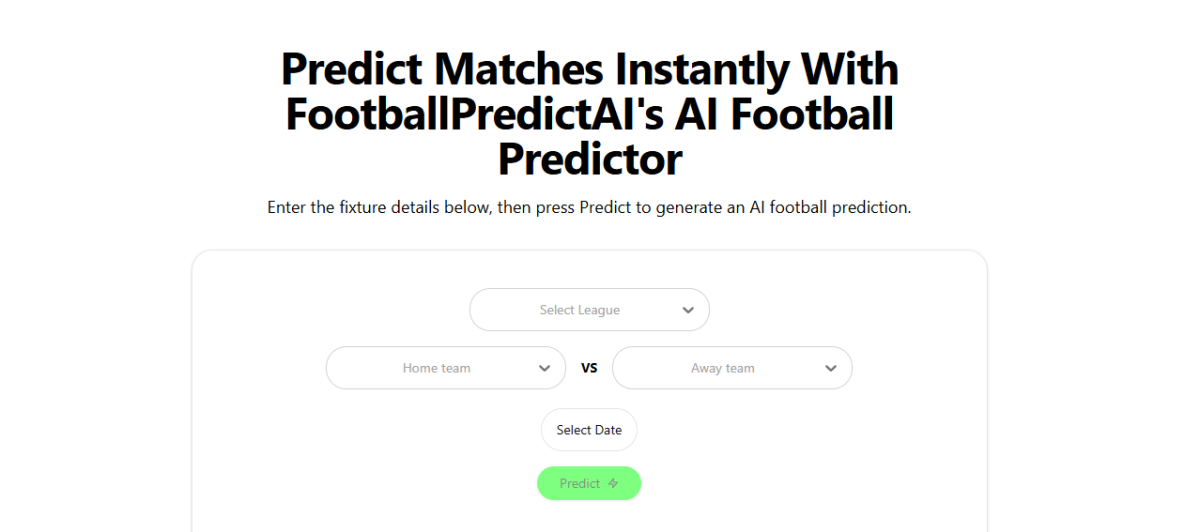
FootballPredictAI is a prediction constructor rather than a feed of ready picks. The user selects a league, both teams and a date, presses Predict, and the model generates output for that fixture on demand. Nothing is predicted until asked. Marketing materials centre on the top European leagues and the Champions League, and the league selector also carries international tournaments such as the World Cup. The product is football-only: no US sport, no tennis, no esports. The narrow focus counts as a point in the service's favour, since models stretched across dozens of sports rarely do any of them well.
Descriptions of the model differ depending on where you read. Marketing materials talk about a 15-year backtest with expected goals, confirmed squads and odds movement among the inputs. The product pages themselves are more modest and name historical match results, recent form and performance indicators. Both versions at least name inputs, which is more than many competitors manage, but the gap between the two descriptions is worth keeping in mind, and this review returns to it below.
One thing to know before reading further: the company's own blog ranks the market into «tiers» and places itself alone at the top of the accessible ones. Take the self-description with the usual salt. What can be verified from the outside is covered below.
How the model works
The service does not publish its architecture, which is normal for a commercial product. What can be trusted most is the on-page description: the model works from historical results, recent form and performance indicators, and outputs cover six labeled markets (1X2, Double Chance, Over/Under, BTTS, and home or away team to score). The site's own limitations section adds that late injuries, lineup changes, weather and data delays can affect predictions. That warning is honest, and it quietly walks back the richer input claims made in the marketing.
Predictions are generated on request, and the service does not say whether repeating the same request later returns the same output. For anyone testing the service this makes record-keeping important. Save the output together with the time it was generated and the odds available at that moment, not the odds shown later.
A real prediction examined
During testing for this review, the model was asked to predict a World Cup semifinal between two top national sides. The output format itself is well designed: a primary pick with a confidence percentage, a likely scoreline, two alternative markets with their own confidence levels, and a written reasoning paragraph. A tip above the result advises using only predictions with confidence of 70% or higher.
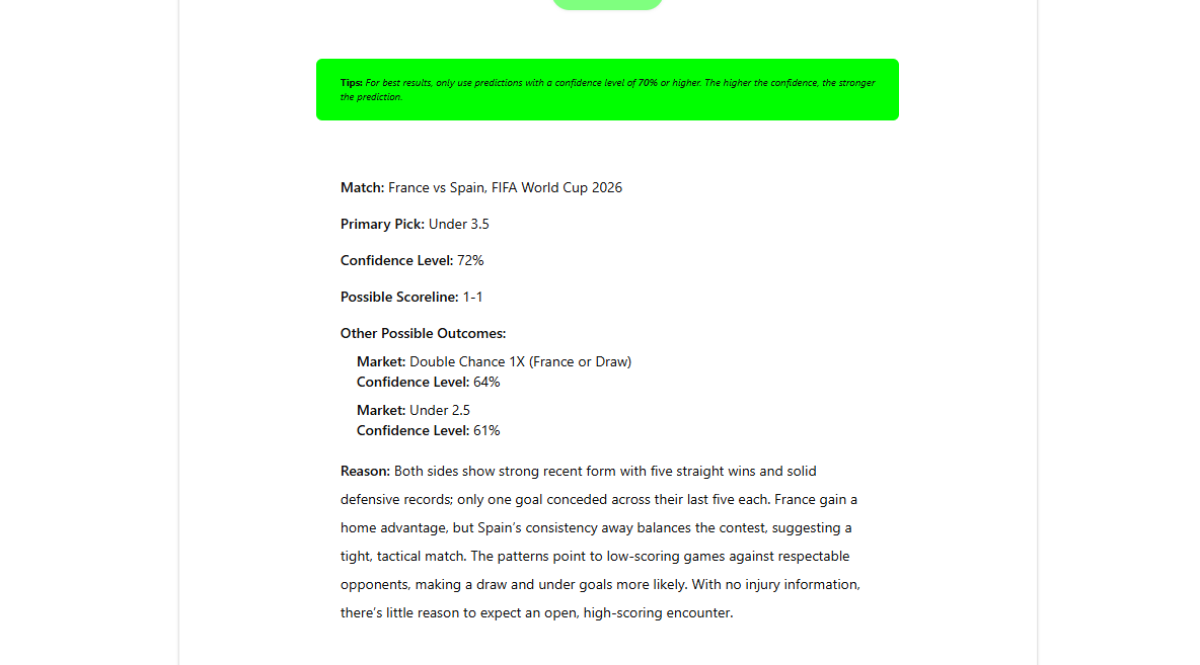
Two details in that output deserve close attention. The reasoning paragraph openly stated that the model had no injury information for the fixture. Credit for the honesty, but this directly contradicts the marketing claim that confirmed squad availability feeds into every prediction. The reasoning also credited the nominal home team with home advantage, although the match was played at a neutral tournament venue. A model receiving genuine live fixture data would know the difference between a bracket position and an actual home ground.
The confidence figures illustrate the market problem covered in the next section. The primary pick was under 3.5 goals at 72% confidence. Most football matches finish under 3.5 goals regardless of who plays, so 72% on that market sits close to the base rate, and a bettor learns almost nothing from it.
The 87% accuracy claim examined
Marketing materials quote 87% accuracy on a 7-day rolling window. The homepage widget showed 82% on the day of testing. That five-point gap between the advertised number and the live one is the first lesson, and three more things hide inside the claim itself.
First, the window. A rolling 7-day calculation only ever describes the most recent week. A strong week produces a strong number, and last month's weak stretch has already left the calculation. This is not fraud, but it is the most flattering honest way to present accuracy, and the number will genuinely be 87% on some weeks and considerably lower on others.
Second, the markets. Accuracy percentages depend heavily on which bets are being counted. A model that includes low-risk markets in its accuracy pool, such as «over 0.5 goals», will show a high percentage without that percentage meaning much for a bettor. The service's public materials do not fully break the figure down by market, so a careful user should do that work themselves during the trial.
Third, the gap between accuracy and profit. Even a genuine 87% on some market says nothing about returns until it is compared with the odds. Being right 87% of the time on outcomes priced at 1.10 loses money. The only test that matters for a bettor is whether the service's picks, taken at the odds available when the picks were published, beat the closing line over a meaningful sample.
The check described above matters twice over here, because FootballPredictAI publishes no archive of its past predictions. The site navigation offers Home, About, Pricing, Contact and Blog, and none of them leads to a track record with graded results. The only accuracy evidence the service presents is the rolling widget itself. For a product whose entire pitch rests on an accuracy figure, the absence of any verifiable history is the single biggest problem this review found.
League coverage
The stated coverage is the top-5 European leagues plus UEFA competitions and cups, and the league selector also carried the World Cup during the tournament. Users can suggest new leagues through a feedback box on the page. That cuts both ways. Data quality for these competitions is excellent, so the model works with reliable inputs. At the same time these are the most efficient betting markets in the sport, where bookmaker lines are sharpest and mispricing is rare. A model has the least room to find value exactly where FootballPredictAI operates.
Bettors who work with lower divisions or smaller countries will find nothing here. For that use case a wide-coverage service is the only AI option, with all the data-quality reservations that come with it. The comparison table in the AI prediction tools hub shows which services cover what.
Pricing and free access
Free access works differently from a normal trial. New users get a free day on signup, and it expires the same day it is issued. Free access covers selected leagues and same-day fixtures only. When ads are available and enabled, watching one unlocks another free day, once every five days. The expiry is enforced in practice: in testing, the day after signup the constructor answered a request for a real same-day fixture with a subscription wall, and no ad-unlock option was offered at that moment. The advertised ad-based free days should be treated as conditional, since they depend on ads being available, and during testing they were not.
Paid access is sold as non-recurring passes rather than a rolling subscription: a multi-day trial pass at the price of pocket change, plus weekly and monthly options, all pay-as-you-go with no automatic renewal or charges after expiry. Current prices sit on the official pricing page and land at the cheap end of this market. One unusual detail: the pricing page routes payment questions to a Telegram support channel that handles cards, bank transfers and USSD, which points at the audiences the service is built for.
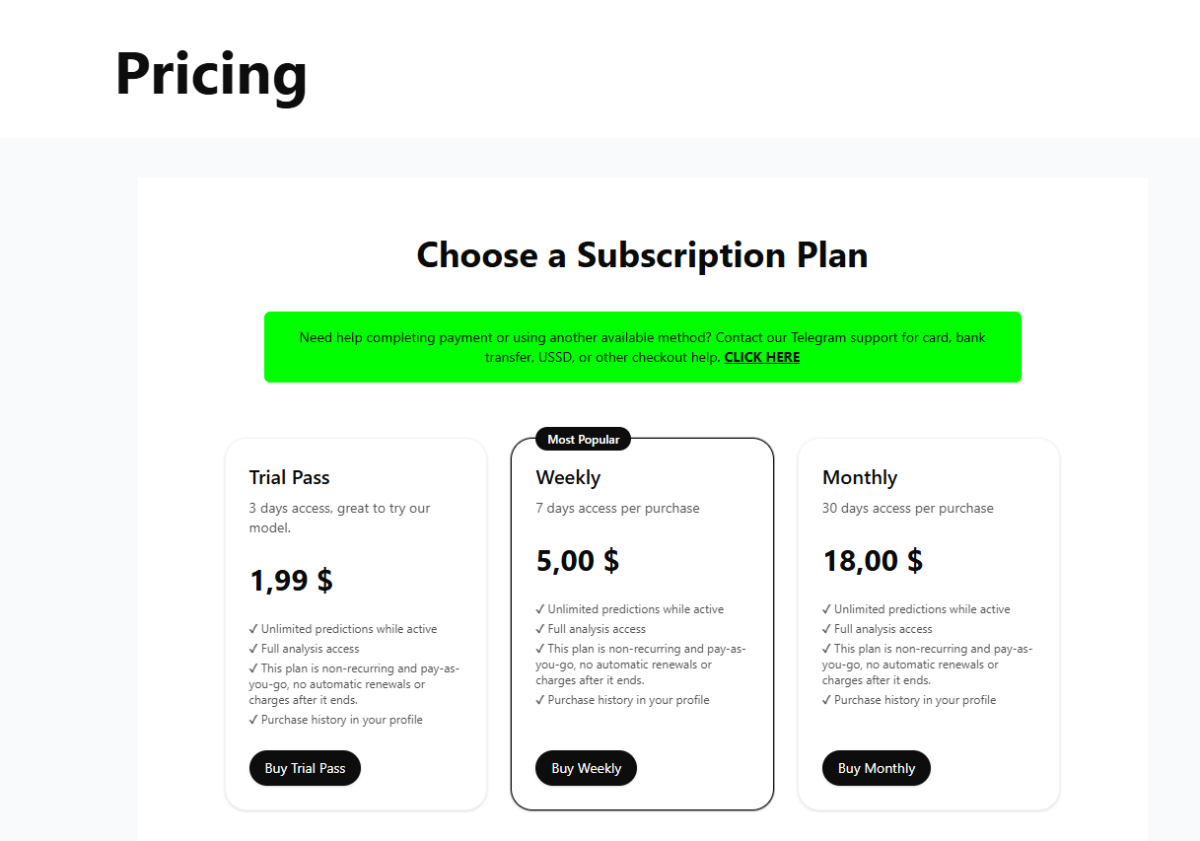
The premium terms contain one oddity worth noting. One section of the homepage promises predictions up to 3 days ahead for premium users, while the FAQ on the same page says 7 days. A small contradiction, but it sits on a sales page of a product that asks you to trust its numbers.
A single free day is too small a sample to judge a prediction model, and here the pass structure helps: the multi-day trial pass makes collecting a proper sample cheap. Save every prediction with the time it was generated and the odds available at that moment, and let that batch decide whether a longer pass happens. A model whose picks consistently beat the closing line has something real behind it. Where the picks fail that test, no rolling accuracy number should convince you otherwise.
Strengths and weaknesses
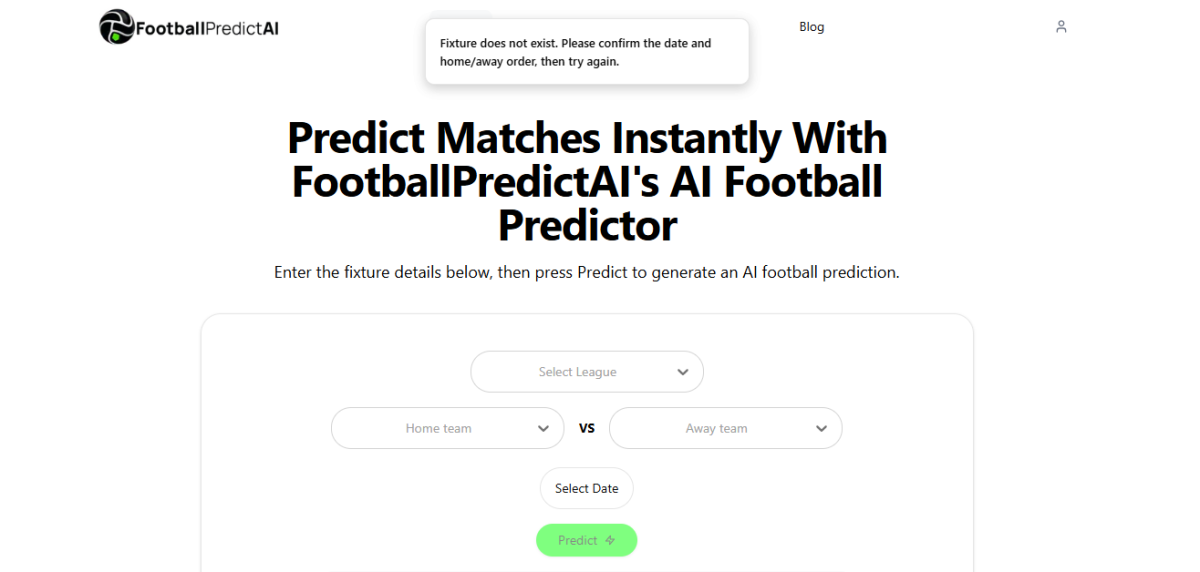
What works. The output format is well designed: every result carries a market label, a primary pick with a confidence estimate, a possible scoreline, alternatives and short reasoning in plain language. The site carries an honest limitations section and a visible responsible gambling logo, which plenty of products in this niche skip. Coverage stays within major, well-documented competitions. The real-fixtures policy holds up in practice: during testing, an invented pairing was rejected with a «Fixture does not exist» error instead of a generated prediction. Paid access comes as non-recurring passes with no automatic renewal, so there is no forgotten-subscription risk.
What raises questions. The biggest problem is the missing track record: an accuracy-first product with no public archive of past predictions. The marketing describes richer model inputs than the product pages do, and hands-on testing leaned toward the modest version, since the model's own reasoning admitted having no injury information and treated a neutral tournament venue as a home ground. The homepage contradicts itself on premium terms, promising 3 days of fixtures ahead in one block and 7 in another. And the covered competitions are the hardest football markets in the world to beat, which limits how much value even a good model can find.
Presentation adds smaller concerns. The team dropdown displays only the first entries of an alphabetical list, and the remaining teams appear only when typed manually. The homepage carries a third-party advertising banner, and the footer links out to tipster sites and a bookmaker under a Partners label, which fits an affiliate operation more than an analytics product. None of this breaks the model, but polish matters in a product that asks for subscription money.
Who FootballPredictAI suits
The service fits bettors who play top-5 European leagues and the Champions League, want a statistical second opinion built from real inputs, and are prepared to verify the output against closing odds themselves. It also suits analytically minded users who want a structured starting point for their own match research.
It does not fit bettors looking for lower-league value, anyone expecting the 87% to translate into an 87% win rate on their own bets, or users who want picks for sports other than football. Bettors in the last group should look at the US-focused tools covered in the hub.
Alternatives
ScoreGPT approaches the same problem from a different direction, running matches through several language models and grading every pick in public; its free weekly allowance and public graded record make it the natural thing to check alongside a FootballPredictAI trial. NerdyTips covers far more leagues at a lower price, with the data-quality trade-offs that follow. Rithmm drops ready-made picks entirely and lets users build their own models, though its football coverage is minimal. All three, and the rest of the market, are compared in the AI prediction tools guide.
Frequently asked questions
Is FootballPredictAI legit?
How accurate is FootballPredictAI really?
Is FootballPredictAI free?
What leagues does FootballPredictAI cover?