
ScoreGPT review: AI football predictions app tested honestly
This ScoreGPT review looks at a football predictions app with one clear idea. Five well-known AI models each predict the same match. The app then combines their answers into one main pick. After the match ends, every prediction is marked as right or wrong, and the full record is public. That record is real. We checked it. The review below explains how ScoreGPT works step by step, what is free and what needs a paid plan, and what the accuracy numbers prove.

Pros
- Every pick is graded on a public leaderboard, losses included.
- Models are named with versions, so the claims can be checked.
- Pick reasoning comes with links to real news sources.
- Free tier needs no account or card: 3 picks every week.
Cons
- The public record covers one competition, while the app sells many leagues.
- The consensus pick scored below every single model at the time of checking.
- Samples are small, and rolling windows show only recent weeks.
- Store marketing sounds far more confident than the legal text.
What ScoreGPT is
ScoreGPT is a mobile app for iOS and Android. It gives football predictions for real matches in major leagues. The predictions do not come from one system. They come from five separate AI models made by different companies. The app names each model and its version openly. Most other prediction tools only say «advanced AI» and give no details, so this openness is rare and useful.
You do not need an account to start. The free version works right after you install the app.
How ScoreGPT works, step by step
The app was confusing for us at first, so here is the process in plain steps.
- The app lists real upcoming matches from the leagues it covers. A match can be analysed up to 48 hours before it starts.
- Each of the five AI models studies the match on its own. The models use live web search to read about team form, injuries and news. They do not share answers with each other.
- Each model gives its own prediction: a score, a confidence number, and a short text that explains the reasons. The text includes links to the news sources the model used.
- A separate system, called the consensus engine, reads all five predictions and produces one combined pick. This combined pick is the main answer the app shows you.
- After the match, every prediction is compared with the real result. Right or wrong, the result goes to a public scoreboard called the accuracy leaderboard.
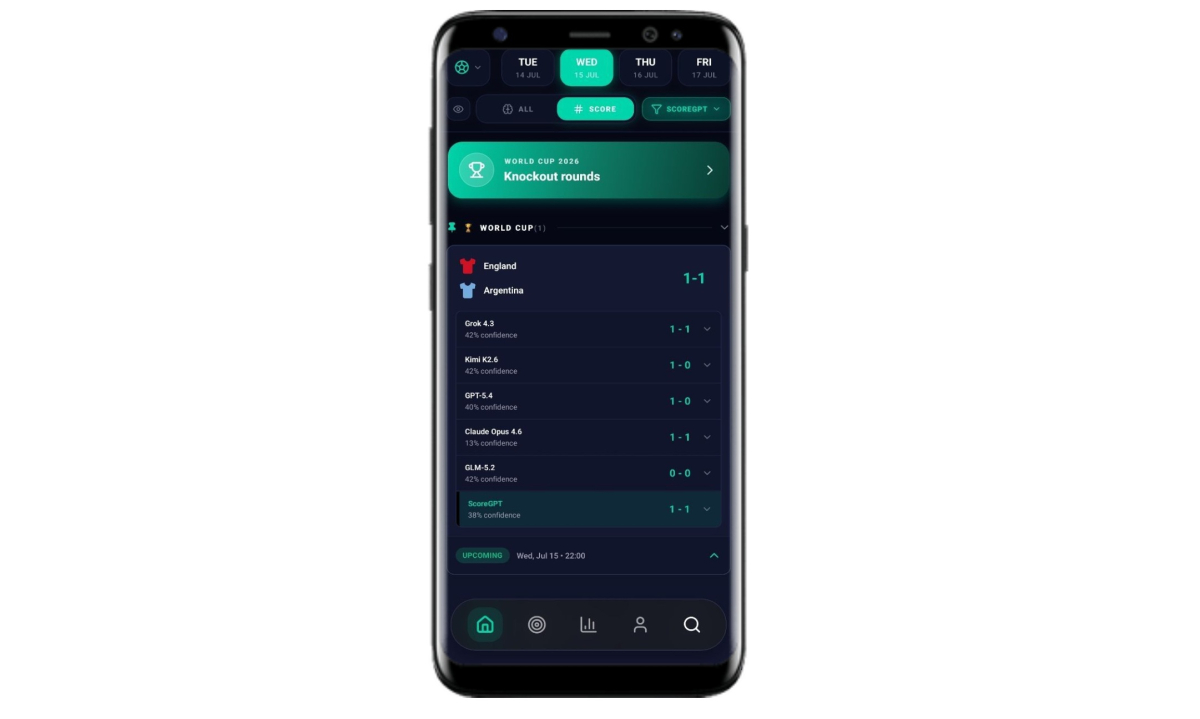
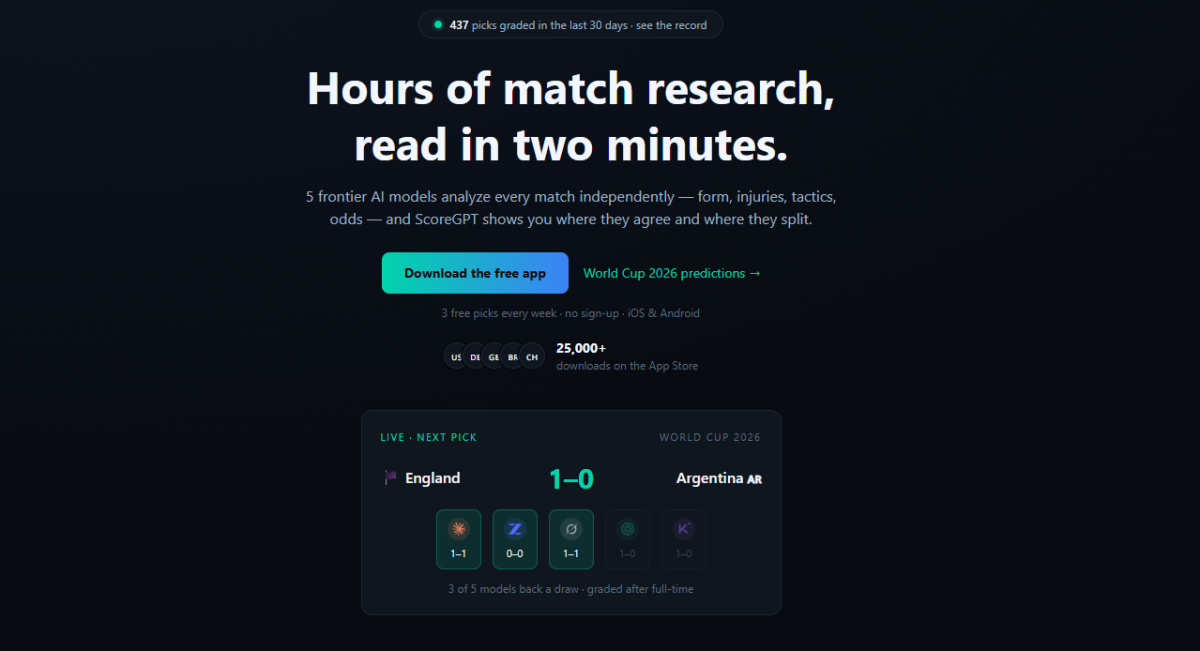
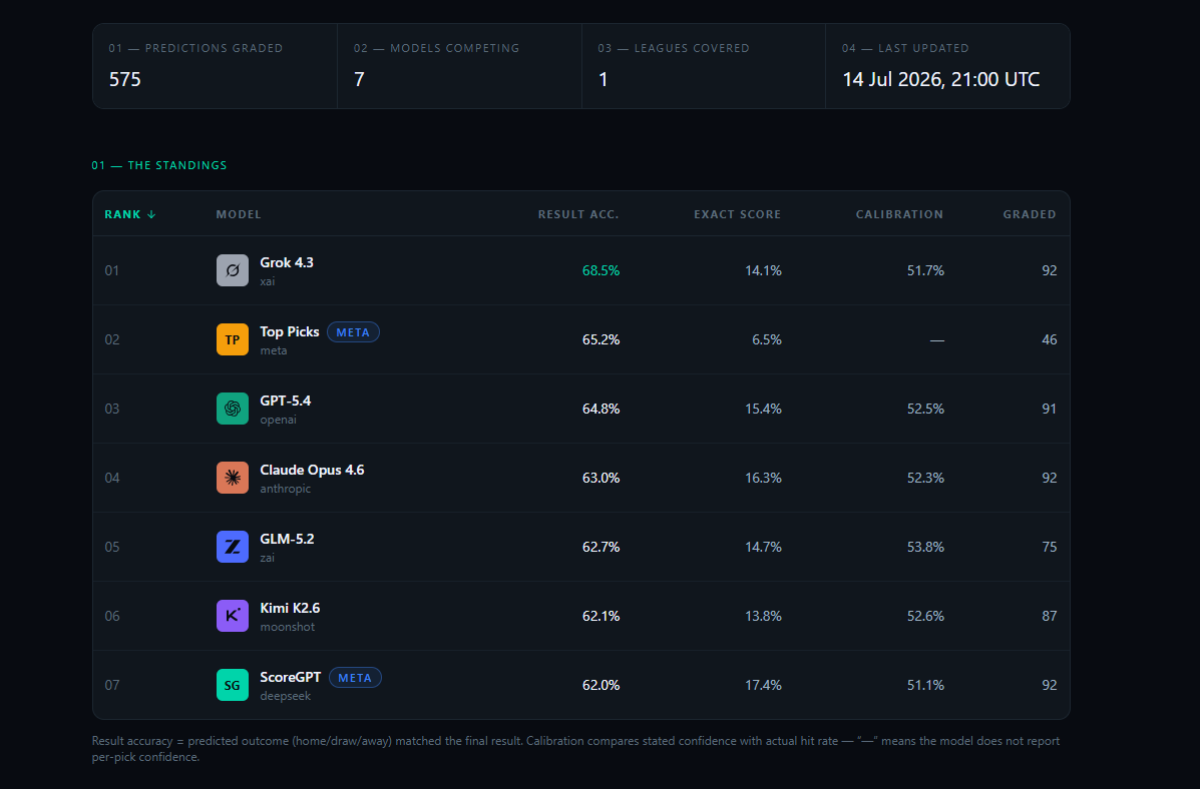
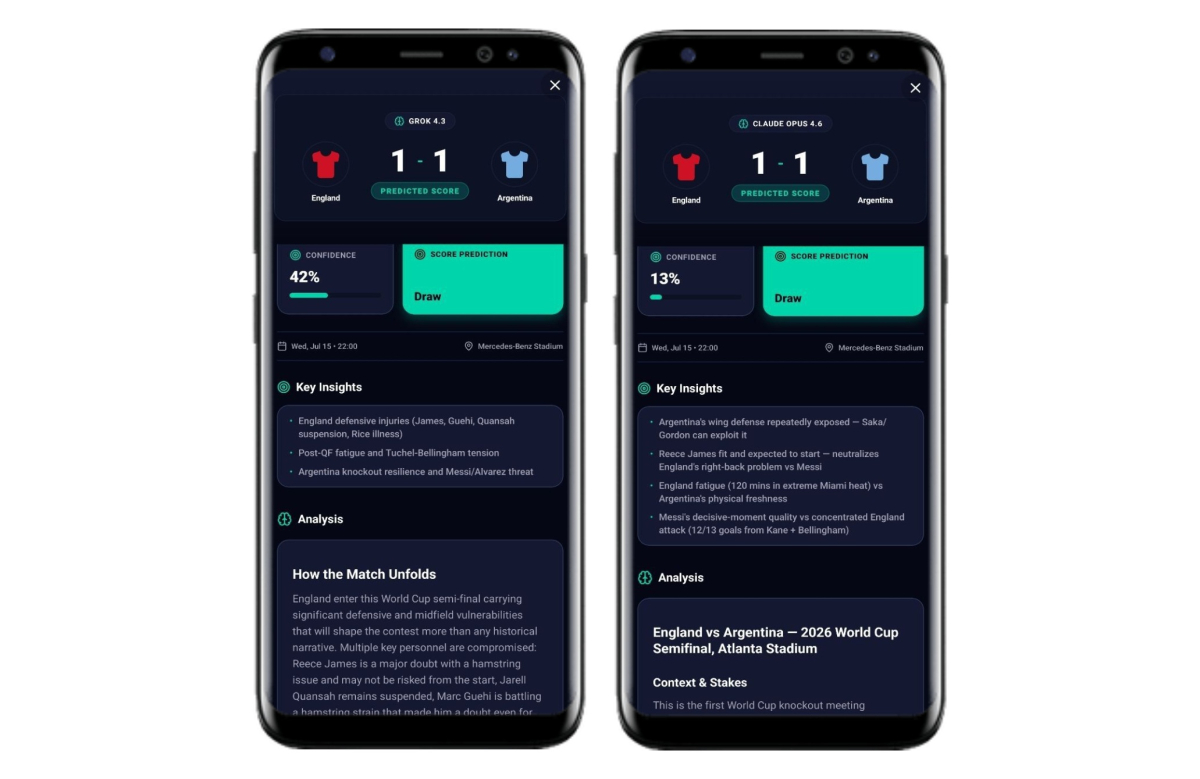
One detail matters here. The combined pick is not a simple vote, and there is more than one way to combine. In a semifinal we checked, three of five models predicted a draw and two predicted a narrow home win. The featured combined score on the website showed the narrow win, while the consensus line inside the app showed the draw. The leaderboard explains this: the system runs two combined entries, called Top Picks and ScoreGPT consensus, and grades each one separately. The combination method changes the answer, and the record treats both methods honestly. That honesty matters: at the time of checking, the ScoreGPT consensus sat at the bottom of its own table, behind every individual model. The combined answer is the easiest one to read, and the record shows it is not automatically the best one.
The public accuracy leaderboard
The leaderboard is the reason this app stands out, so we checked it first. It exists at scoregpt.app/accuracy, it is free to read, and it updates after every finished match.
For each model, the page shows four things. Result accuracy: how often the model called the match result (home win, draw or away win) correctly. Exact score: how often the model guessed the final score exactly. Calibration: does the model's confidence match reality. In simple words, a well-calibrated model that says «70% sure» should be right about 70% of the time. The need for this column is easy to see in practice. In our test fixture, two models gave the same draw prediction with very different confidence: 13% from one, 42% from the other. Sample: how many predictions were graded.
At the time of checking, result accuracy across the models was between 60% and 68% over the last 30 days, with up to about 100 graded matches per model. These numbers are believable. Serious research says the best public football models reach about 55–60% over long periods. A slightly higher number during one tournament month is normal, and it is not proof of a lasting advantage.
Three rules protect the record. All models get the same saved match information before kickoff, so nothing can be changed later. Predictions lock before the match starts. Results are graded automatically, and losses stay visible.
The record also has limits, and they matter. The numbers cover rolling windows of 7, 14 and 30 days. Rolling means only the recent days count, so the numbers describe recent weeks, not the whole history of the product. The samples are small, and the site itself warns about this. And at the time of checking, the graded record covered only one competition, while the app sells predictions for many leagues. A record this well built should cover everything the app predicts. Today it does not.
The betting experiment
The site also runs a simple test. Each model «bets» one virtual unit on its own pick in every graded match. A unit is a fixed bet size, not real money. The page then shows each model's profit or loss in units.
At the time of checking, every model was in profit over the last 30 days. Read this carefully. One good month on a small sample proves very little. Results like this can happen by luck. The site says the same thing in plain text, which is honest. What the experiment really proves is the process: real picks, recorded odds, equal bets, automatic grading, losses included. If the profit continues over many months and thousands of picks, it becomes interesting. One month is only a start.
What is free and what costs money
ScoreGPT is often called a free app. That is only partly true, and our own category guide made the same mistake before this check. Here is the real structure.
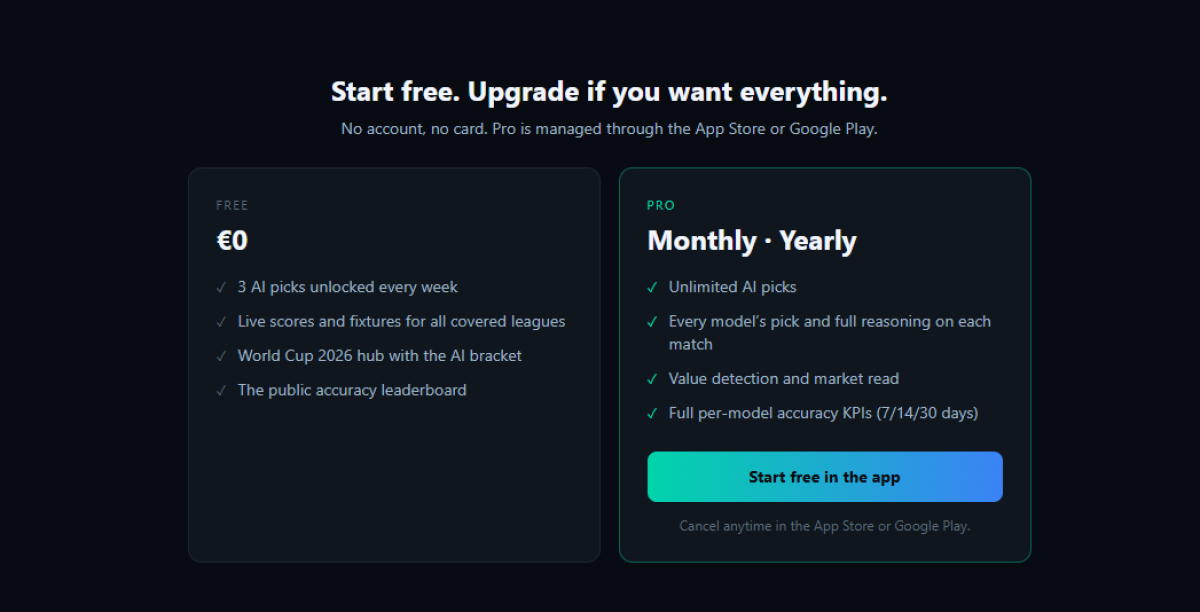
Free, with no account and no card: three AI picks per week, live scores for all covered leagues, the tournament hub during big tournaments, and full access to the public leaderboard.
Pro, a monthly or yearly plan: unlimited picks, every model's individual prediction with full reasoning for each match, value detection, and complete accuracy dashboards. The site does not show the Pro price. The price is inside the App Store and Google Play, and the plan is managed and cancelled there. This setup is safe for the user: no card is asked before you decide to pay.
Value detection needs a short explanation. It marks matches where the model's estimated chance is higher than the chance suggested by the bookmaker odds. This is a standard idea in betting analysis. Treat these marks as a reason to look closer, not as an order to bet. Model estimates are least reliable at long odds.
Three free picks per week will show you the product, but a fair judgement of the models needs a much bigger sample. The leaderboard helps here, because it is free and open to everyone, so the record can be studied without paying anything.
What AI models can and cannot do here
A short and honest note about the method. Language models are not statistics engines. They read information and reason about it. This makes them good at weighing context: motivation, tiredness, what the match means for each team. It does not give them secret data. The bookmaker odds already contain the opinions of professional bettors, so beating those odds is very hard for any system.
The useful signal is agreement. When five independent models point the same way, the available information points that way too. When they split, the match is probably harder than the odds suggest. Treat the panel as a second opinion with a public record, and it earns its cost in time. Nobody should expect a machine that knows the future, because such a machine does not exist.
One review in the App Store shows why this warning matters. A user won with the first free picks, paid for a year of Pro, and then lost heavily. The developer answered that ScoreGPT is an information and entertainment tool, not betting advice. Both statements can be true at the same time. The user's money sits in the gap between a confident store page and a legal text that guarantees nothing.
Strengths and weaknesses
What works. The public record with visible losses is the best transparency setup in this category. The models are named with versions, so the claim can be checked. The reasoning behind picks includes links to sources, which almost no competitor offers. The accuracy numbers are realistic instead of inflated. The free tier needs no account and no card. The leaderboard is free for everyone.
What raises questions. The graded record covers one competition, while the app sells many leagues. The samples are small, and rolling windows show only recent weeks. Some site pages lag behind the product: the About page still shows an older model list and an older free limit, while the homepage, pricing block, FAQ and store listing all agree with each other. The onboarding screens lean the same way: the «proof» screen quotes numbers that match the strongest individual model, while the combined pick most users will follow scores lower on the same leaderboard. And the store marketing sounds more confident than the legal text, which is a common problem in this niche but still a problem.
Who ScoreGPT suits
The app fits fans and bettors who follow the top leagues and want a second opinion with a record they can check. It also fits anyone who wants to watch named AI models compete on a public scoreboard, which is honestly fun. It does not fit users who need lower-league coverage, and it does not fit anyone who expects a paid app to beat the bookmaker odds on demand.
Alternatives
FootballPredictAI covers similar leagues with one statistical system and no public record. After both reviews the difference is simple. FootballPredictAI is cheaper to enter, while ScoreGPT offers much stronger proof of its work. NerdyTips covers far more leagues with less transparency. Rithmm gives no ready picks and lets users build their own models, mostly for US sports. The full comparison is in the AI prediction tools guide.
Frequently asked questions
Is ScoreGPT really free?
How accurate is ScoreGPT?
Which AI models does ScoreGPT use?
Is ScoreGPT betting advice?