
How to calculate CLV and strip out the bookmaker's cut
You can lose a bet that was right and win a bet that was wrong. Closing line value is the number that tells the two apart, and it works on the price you paid rather than the result. This guide shows how to work it out in decimal odds, and why the usual answer is too generous.

Pros
- Work out CLV from any two prices.
- Strip the bookmaker's cut out and see the honest number.
- Read the sum in decimal or American odds.
- Know how many bets it takes before the number means anything.
Cons
- It cannot find closing prices for you.
- It cannot tell you how much to stake.
- It will not help on markets with no real closing price.
- It says nothing about whether a bet won.
Odds are a price, and the price moves
Decimal odds tell you how much comes back. At 2.10, a stake of 100 returns 210 if the bet wins. The bigger the number, the better the deal for you.
That number does not stay still. A bookmaker puts a price up days before the match and then changes it, sometimes many times. A team can be 2.10 in the morning and 1.95 by the evening.
Two things cause that line movement. New information, such as an injury, a team sheet or heavy rain. And money, because when most people back one side, the bookmaker lowers the price on that side. A sportsbook that ignored both would soon be taking one-sided bets it cannot afford.
The last price before the match starts is called the closing line. It is the market's final answer, and it holds everything that became known along the way.
What closing line value means
Closing line value, or CLV, compares the price you took against the closing odds. Beat the closing line and you bought better than the market's own final answer.
Say you backed a team at 2.10 and the price closed at 1.95. You got the better deal. Your 100 pays 210 if it wins, while everyone who bet after you gets 195 for the same outcome. That is positive CLV.
Now say you took 1.90 and the price drifted out to 2.05 by kickoff. Late bettors got more back than you did for the same bet. That is negative CLV.
Both of those happen before a ball is kicked, and neither depends on whether your bet wins.
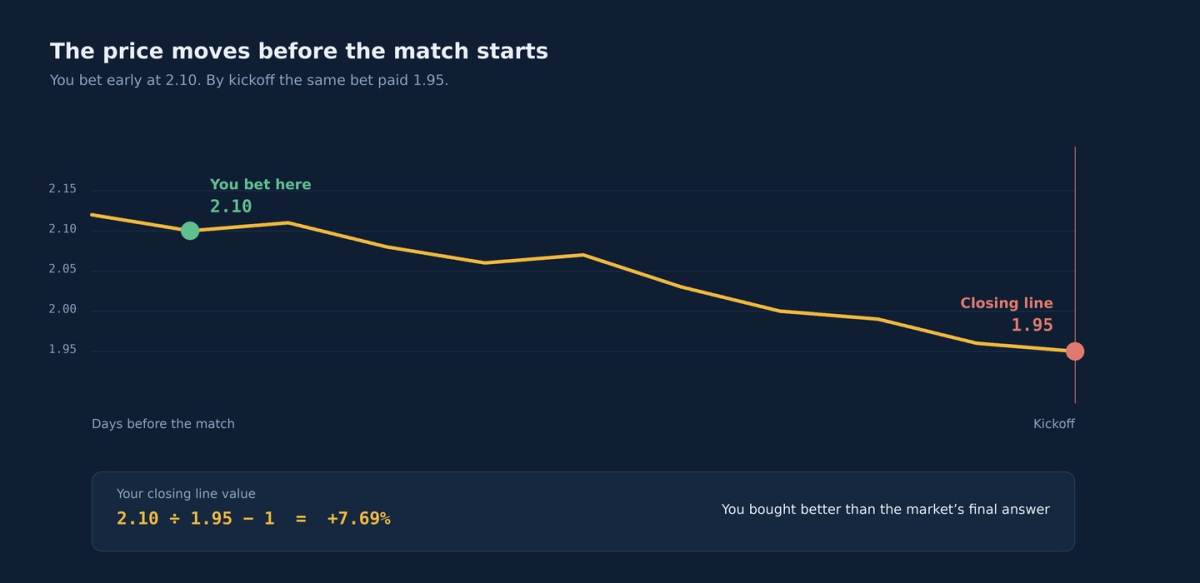
One result is partly luck, but the price you paid was fixed before the match. If you keep buying at better prices than the market ends up at, you are seeing something the market has not seen yet.
The closing price is the market's final answer. Beat it often enough and you are not lucky, you are early.
Why the last price is the important one
The first price a bookmaker puts up is one person's guess. It goes up days early, before the teams are known, and it is padded to be safe.
By kickoff that price has been corrected many times. Every injury, every team sheet and every bet placed by everyone else has pushed it one way or the other. So the closing price is the best guess anyone has about how likely the outcome really is.
Beating it once proves nothing. Doing it across hundreds of bets is hard to explain by luck.
CLV measures your decision, not the result
Good CLV does not save a bet that loses, and bad CLV does not stop one from winning.
Your results tell you what happened in one match. CLV points at your long-term profitability instead, because it measures whether you bought at a good price.
Good CLV does not save a bet that loses, and bad CLV does not stop one from winning. It measures the price, never the result.
Over a season the prices you paid decide your profit. Single results move the total up and down around it.
CLV is also worth checking when your record looks fine, because a good-looking record can hide a real problem.
Every price has a win rate you need just to break even, which means ending up with the same money you started with. At 2.10 you need to win 47.6% of the time. At 1.80 you need 55.6%, because each win pays you less.
So a bettor who wins 55% of bets at 1.80 is slowly losing money. And a bettor who wins only 48% at 2.10 is ahead. A win rate on its own tells you almost nothing without the price beside it.
Closing line value calculator
Enter the odds you took and the odds at kickoff. Decimal (2.10) or American (+110) both work.
The last price before the match started, on the same selection.
Type the closing odds of the other outcomes in the same market, from the same bookmaker. Over and under needs one. A football match result needs two.
CLV compares prices, not outcomes. A bet with good CLV can still lose. Betting should stay entertainment.
How to calculate CLV
The sum is one division. Take your price, divide it by the closing price, then subtract one.
You took 2.10. It closed at 1.95. That is 2.10 ÷ 1.95 = 1.0769. Subtract one and you have 0.0769, which is +7.69%.
Try it the other way. You took 1.90 and it closed at 2.05. That is 1.90 ÷ 2.05 = 0.9268, so −7.32%. A minus number means the market moved away from you.
Most American guides do this differently. They work in American odds. Their main markets are the moneyline and the point spread, which is a handicap counted in goals or points. So they measure the move in points instead. In decimal odds none of that is needed. One division covers every market: match result, over and under, both teams to score.
Why that number overstates your edge
The simple sum has a problem. Understand it before you trust the answer.
Every price contains the bookmaker's cut. Turn each price in a market into a chance by dividing one into it, then add them up. The total comes to more than 100%, and the excess is what the bookmaker keeps. Our odds converter does that sum for any market and shows the fair prices underneath. Here it is enough to know the size of the effect.
Take the same example. Both sides of the market closed at 1.95, which totals 102.56%, so the cut was 2.56%. Strip it out and each side is a true 50%, a fair price of 2.00. Your 2.10 against a fair 2.00 is an edge of 5.0%, not the 7.69% the first sum gave you.
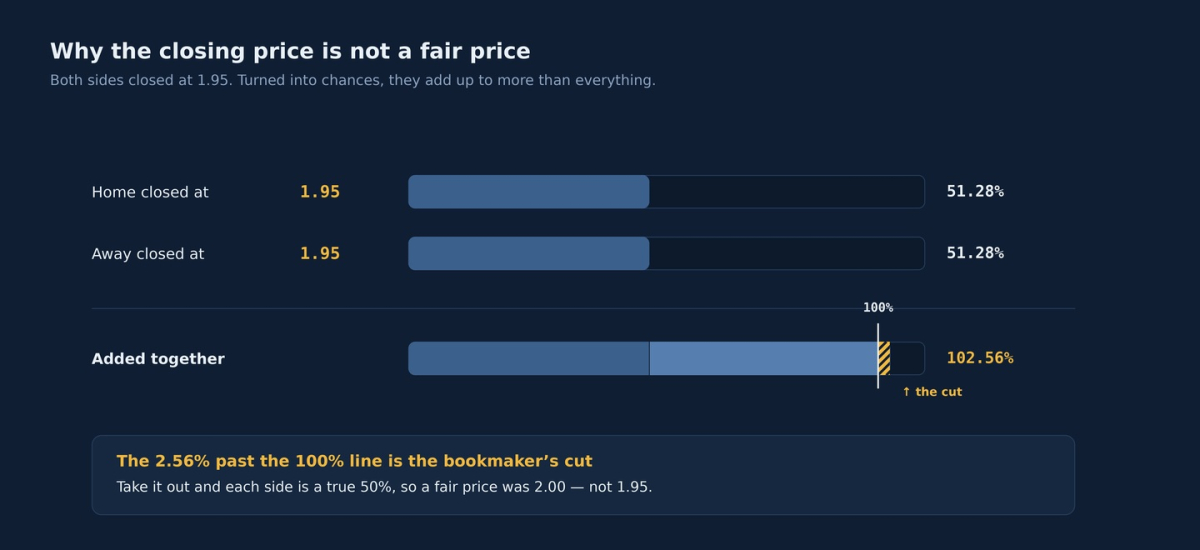
Most CLV calculators stop at one division and hand you a number bigger than your real edge.
A football match result works the same way with three prices instead of two. Say a match closed at 2.30, 3.40 and 3.20. Those total 104.14%, so the cut was 4.14%, and the fair prices come out at 2.40, 3.54 and 3.33. If you had backed the home side at 2.55, the simple sum says +10.87% while your real edge was +6.46%.
The gap grows with the cut. So a tracking app reporting the simple version flatters everyone who uses it. That is why the calculator on this page asks for the other outcomes.
Which bookmaker's closing price to use
Your CLV is only as good as the closing price you compare against, and not every bookmaker's price is worth using.
You want a sharp bookmaker. Sharp here means a betting site with a small vig and high limits, where a limit is the largest stake it will accept. High limits attract people who bet seriously and in size, and their money corrects the price faster.
Pinnacle is the usual choice, and most CLV calculator tools quote it. It works as a market maker, which means it sets a price and moves it as money arrives instead of copying other sites. Its vig is small, so its closing odds already sit close to a no-vig price.
Do not compare against a bookmaker with a wide cut, including the one you bet with. You would be measuring a padded price against a padded price, and both distortions stay in the answer.
For football outside the big leagues there may be no reliable closing price at all. The market is the limit here, not anything you did wrong. Know it before you build a habit around a number you cannot always collect.
Where to find the closing price
You need the price as the match starts, and you need to write it down before it disappears.
Some bet trackers work as a CLV tracker: they collect the closing odds for you and calculate CLV automatically. Betstamp and Pikkit both do it. Zort does not, which is worth knowing before you pick one, because this is the feature that separates them.
Without a tracker you do it by hand. Odds comparison sites keep closing prices for major markets, and some publish free archives for the big European leagues. Oddspedia and OddsPortal are the usual free sources.
A betting exchange is another option. On an exchange you bet against other people rather than against a bookmaker, so the price has no bookmaker's cut inside it. The Betfair price at the moment a match starts works as a reference for the same reason.
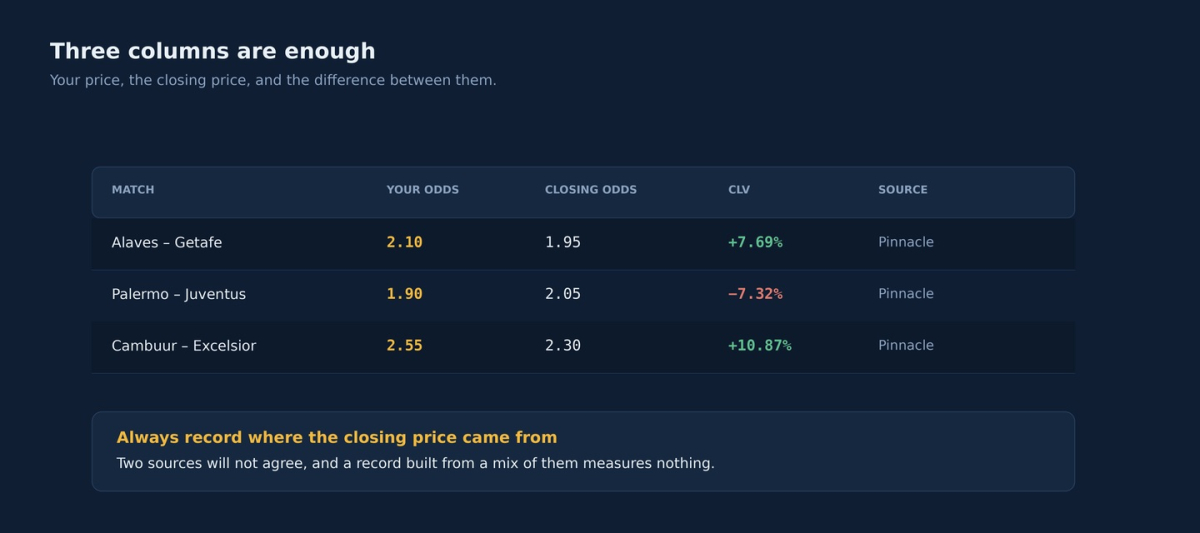
Whichever you pick, use the same source every time. Two sources will not agree, and a record built from a mix of them measures nothing. If you would rather keep the record yourself, a spreadsheet handles three extra columns without trouble.
How many bets before this means anything
One bet with good CLV tells you nothing at all. The useful question is how many bets you need before the number describes you rather than luck.
Two numbers are worth keeping. The share of bets where you beat the closing line, and your average CLV across all of them. Take the share first. If you were guessing, it would sit near half.
The trouble is variance, the normal swing of results around their true value. It moves that share a long way when you have few bets. Over 50 bets it can swing about 14 points in either direction. Over 100 bets it is about 10 points. Over 300 it is under 6, over 500 under 4.5, and over 1,000 about 3.
So beating the close on 55% of 50 bets proves nothing, because luck alone covers a swing that size easily. The same 55% over 500 bets is a real signal, because luck rarely stretches that far.
Beating the close on 55% of 50 bets proves nothing. The same 55% over 500 bets is a real signal.
The honest timeline follows from that. If you place a few bets a week, it is a season or more before your CLV record says anything about you.
What a small edge is actually worth
Edges measured this way look tiny, and they are. They still add up, because they repeat.
Take an edge of 2% and a stake of ten units on each bet. A unit here is just your normal stake, usually a set share of your bankroll, which is the money you have put aside for betting. Over 100 bets that edge returns twenty units. Over 500 bets it returns a hundred.
At an edge of 5%, the same volumes return fifty units and two hundred and fifty.
A single bet at 5% edge changes nothing. The number matters because it applies to every bet you place after it.
What CLV cannot tell you
It cannot tell you whether you will be paid. Beating the close is worth nothing if the bookmaker restricts your account. A restriction cuts the largest stake it will take from you down to a few coins. The same applies if your stake is refused, or if you cannot fund the account at all.
Some markets have no real closing price to begin with. Bets on a whole season, novelty markets and small competitions either barely move or have no dependable price at kickoff.
Two bettors comparing their CLV are often comparing nothing. The simple sum gives a different answer from the fair-price version. So does a different closing source, or a market priced in point spreads. None of those numbers sit side by side.
Stake size is a separate question entirely. Knowing your price was good says nothing about how much to put on it, and that has its own method.
Using it without overrating it
Track CLV if you bet on markets that have a real closing price, in a spreadsheet or in a tracker that collects the closing odds for you. You also need enough bets for the number to settle down. Record three things each time: your price, the closing price, and where the closing price came from.
Skip it if you bet occasionally for fun, or on markets where a closing price barely exists. You would collect a number too noisy to read.
The value of CLV is that it separates the quality of your decision from the result of the match. Your profit and loss column cannot do that.
Frequently asked questions
What is closing line value?
How do you calculate CLV in decimal odds?
Does positive CLV mean the bet wins?
Which bookmaker's closing odds should I use?