Dutch betting: one payout, several picks
Bet on two or three outcomes of one match, and this dutching calculator shows how much to put on each so that every bet pays the same.

Pros
- Same payout from every pick
- Profit target mode works backwards
- Shows the combined odds
- Reads commas and US odds
Cons
- No each-way or lay bets
- Does not check live prices
- Six picks at most
- Rounded stakes give uneven payouts
Dutching calculator
Live — edit any numberTap to editEnter odds and a total. We split it so every pick pays the same.
What dutching means
Dutching, or dutch betting, means betting on two or more outcomes of the same event. Your total stake (the money you bet) is split so that each bet pays back the same amount. Each outcome you bet on is called a pick.
Take a match with a home win at 2.00 and a draw at 4.00, and you think one of the two will happen. Put 50 on the home win and 25 on the draw, 75 in total.
- Home win: 50 × 2.00 = 100
- Draw: 25 × 4.00 = 100
Whichever of the two happens, you get 100 back and keep 25 as profit. If the away team wins, both bets lose, and so do your 75.
A plain 50/50 split works differently. With 50 on each pick, a home win returns 100 and a draw returns 200, so the result decides how much you make. Dutching takes that swing out, and you know the payout before the match starts.
With round odds like 2.00 and 4.00 you can work this out in your head. With odds like 2.37 and 3.85 you can't. That is what a dutching calculator is for.
How to use the calculator
Using the calculator takes three steps. The numbers update as you type.
- Type the odds of each outcome you want to bet on. The calculator starts with decimal odds (like 2.50). American (+150) and fractional (3/2) odds are under “Options”.
- Type the total you want to bet in the box next to “Total to bet”.
- Place the amounts from the “Bet this” column at your bookmaker. Each pick is its own single bet.
Under the stakes, the result box shows the profit if one of your picks wins, what each pick pays, what you lose if none of them wins, and the combined odds of all your picks together.
Try the “Home or draw” example. With a home win at 2.50, a draw at 3.40 and 100 to bet, the calculator says 57.63 on the home win and 42.37 on the draw. Each pick pays 144.06, a profit of 44.06.
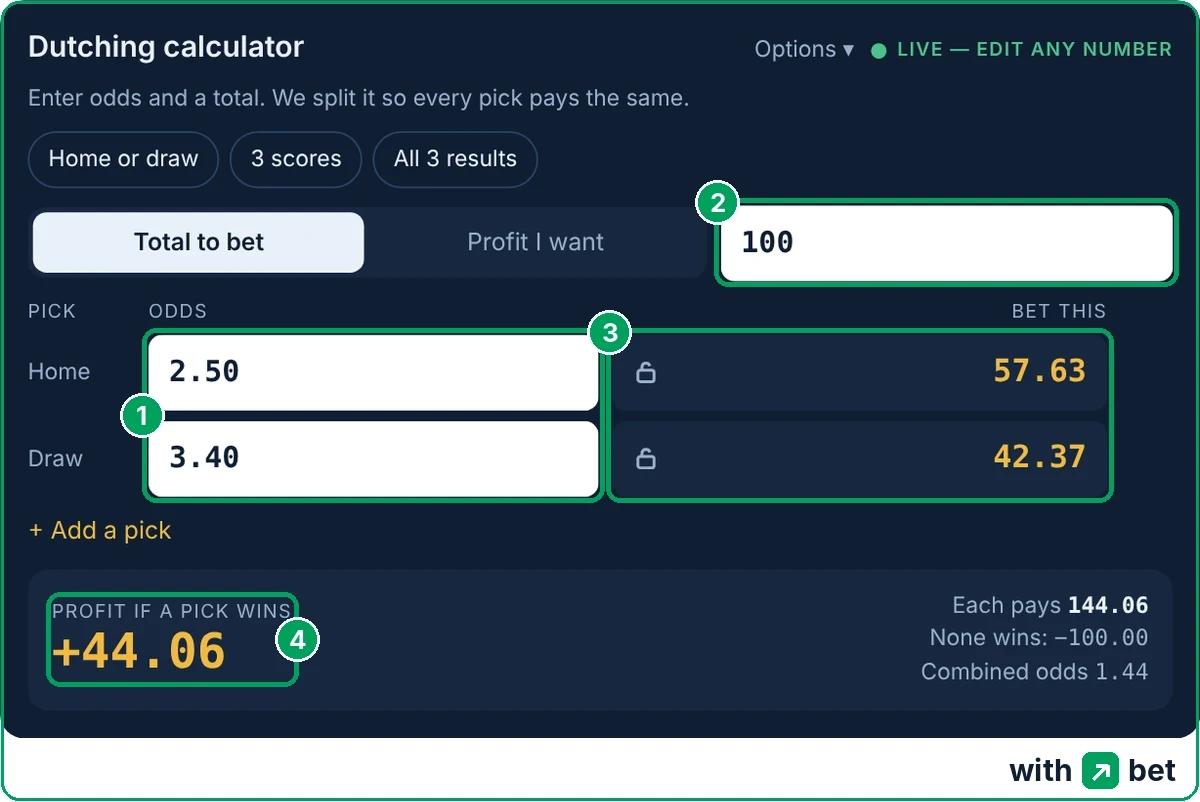
The odds field accepts “2.5” and “2,5”, and the total box accepts “1,000” and “1 000”. If you prefer whole numbers, open “Options” and round the stakes to 1 or 5. The payouts then stop being exactly equal, and the calculator shows the profit as a range, for example +42.80 to +45.00.
Win a set amount instead
Sometimes you know the profit you want, not the total. Switch the box to “Profit I want” and type that number. Some sites call this fixed-profit dutching.
Say you want to win 20 on the same home win at 2.00 and draw at 4.00. The calculator asks for 40 on the home win and 20 on the draw. That is 60 in total, and either pick pays 80. The total box and the profit box each keep their own number, so you can switch between them without retyping.
Dutching is not a surebet
Both methods split one stake across several outcomes, so they are easy to mix up.
In a surebet, also called an arbitrage bet, you cover every possible result of the event, at prices from different bookmakers. Whatever happens, you win. In dutching you cover only some of the results. If one of the others comes in, you lose the whole total.
With dutching you can still lose money, just like with any other bet. To check whether a set of prices covers every result with a profit, use our surebet calculator.
Too many picks lose money
Every extra pick makes a win more likely and the profit smaller. Add enough of them and the profit turns negative. Bettors call this over-dutching.
Take the “All 3 results” example: home 2.50, draw 3.40, away 3.00. Bet 100 on all three and one of them is certain to win. But every pick pays only about 97.32, so you lose about 2.68 whatever the score. The calculator shows this loss in red.
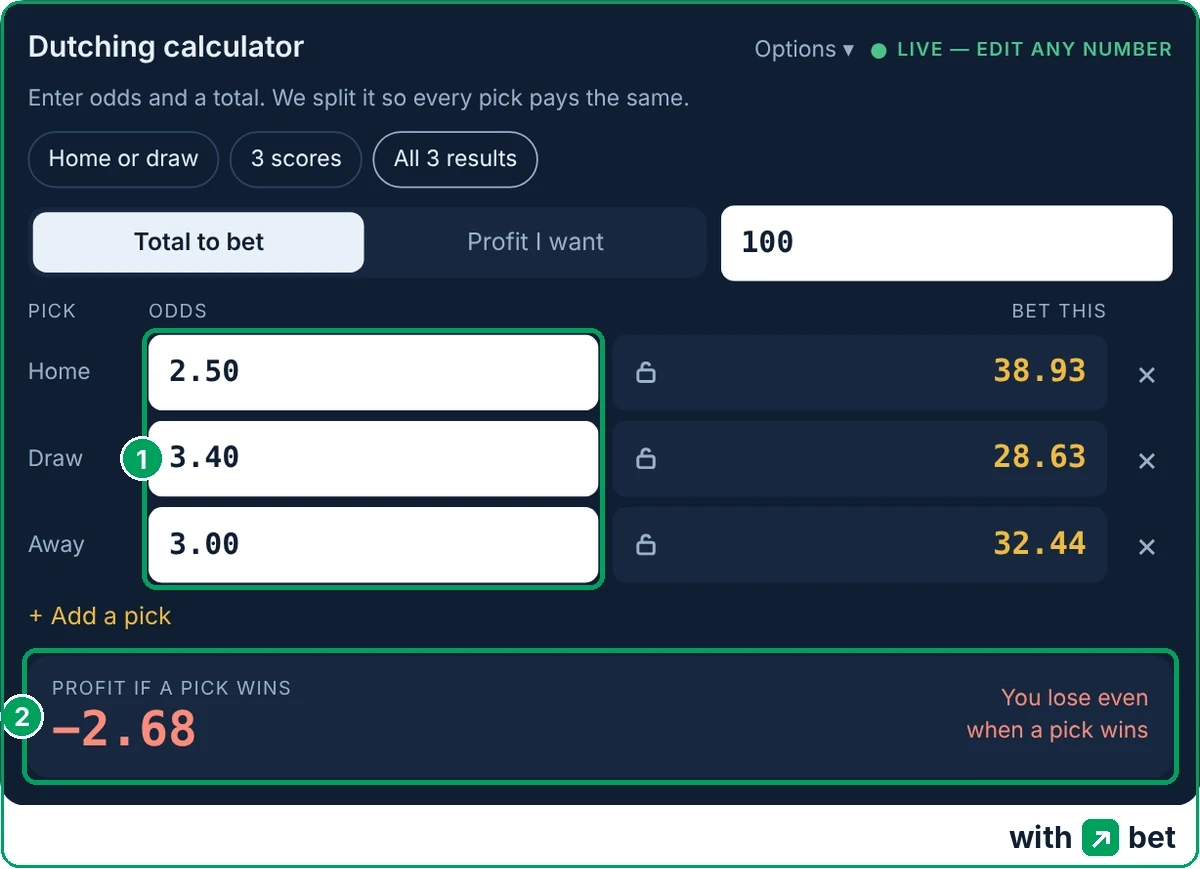
This loss is the bookmaker's margin, the small fee built into every price. You can see it by turning each price into a chance with 1 ÷ odds: 1 ÷ 2.50 = 40%, 1 ÷ 3.40 = 29.4%, 1 ÷ 3.00 = 33.3%. Together they make 102.75%, not 100%. The extra 2.75% is the margin, and when you bet on every result you pay all of it.
Correct scores show the same effect. Here is what happens to 30 as the picks grow:
| Picks | Combined odds | Profit if a pick wins | Chance by the odds |
|---|---|---|---|
| 1-0 at 7.00 | 7.00 | 180.00 | 14.3% |
| + 2-0 at 9.00 | 3.94 | about 88 | 25.4% |
| + 2-1 at 9.00 | 2.74 | 52.17 | 36.5% |
| + 3-0 at 11.00 | 2.19 | 35.78 | 45.6% |
Column four shows the chance that one of the picks wins, as the bookmaker's odds see it. With every new pick the chance grows a little, while the profit shrinks a lot. Keep the picks you really believe in and drop the rest.
Combined odds: check before you bet
Under the profit, the calculator shows “Like odds”. That is the price of your whole dutch, as if it were one single bet. For the home win at 2.50 and the draw at 3.40 it is 1.44.
Many bookmakers already sell some of these combinations as one bet. “Home or draw” is a double chance bet, often marked 1X. Before you place two bets, look at the bookmaker's 1X price:
- If 1X is 1.40, your two bets at 1.44 pay more. Dutch.
- If 1X is 1.48, the single bet pays more. Place that one bet instead of two.
The same check works with “either team to win”, often marked 12. If you work in American or fractional odds, our odds converter turns them into decimals in a second.
Dutching correct scores
Correct score is a natural market for dutching in football. A single score pays big odds but rarely comes in, so bettors often bet on the two or three scores they think are most likely.
The “3 scores” example bets on 1-0 at 7.00, 2-0 at 9.00 and 2-1 at 9.00. With 30 to bet, the calculator asks for 11.74, 9.13 and 9.13. Any of the three scores pays 82.17, a profit of 52.17. Any other score, and the 30 is gone.
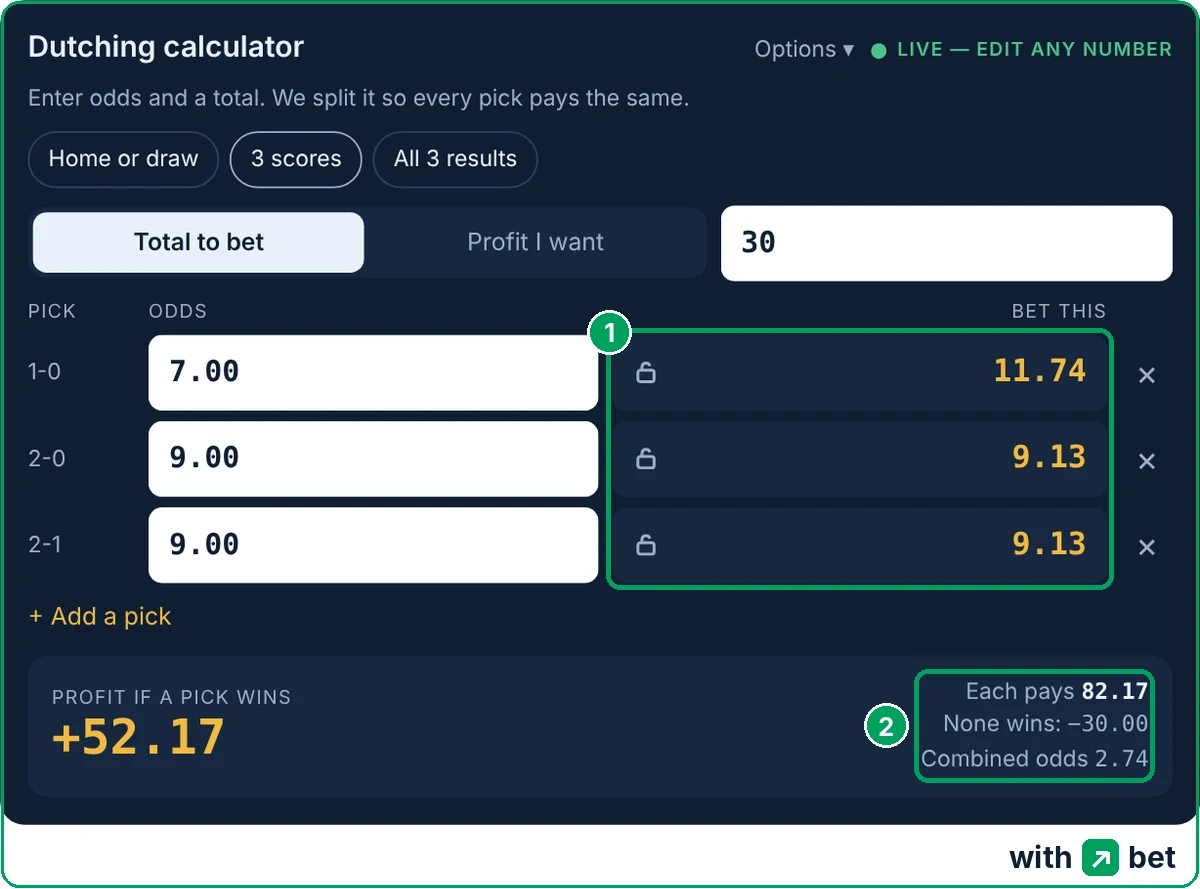
A combined price of 2.74 means the bookmaker gives these three scores together a chance of about 36.5%. The bet is worth making only if you believe the real chance is higher.
Dutching in horse racing
Dutching is most often linked with horse racing, where a race can have ten or more runners. You like three horses in a race of twelve, at 4.00, 6.00 and 8.00. With 50 to bet, the calculator puts 23.08, 15.38 and 11.54 on them. Whichever of the three wins, you collect 92.28, a profit of 42.28.
Prices in racing move a lot before the start. Enter all your prices, then place the bets quickly one after another. If a price changes halfway through, the payouts stop matching exactly, because the bets you already placed cannot be changed.
Take each price from the best bookmaker
Your picks do not have to be at one bookmaker. Each pick is a separate single bet, so you can take each price where it is highest.
For example, move the home win from 2.50 to 2.60 and keep the draw at 3.40, and the combined odds rise from 1.44 to 1.47. On 100, the profit grows from 44.06 to 47.32. An odds comparison site shows where each price is best.
Place the bets one right after the other. If the odds change between two bets, the payouts are no longer equal.
The formula behind the split
The dutching formula takes four short steps.
- Turn each price into a share: 1 ÷ odds. For 2.50 that is 0.4000, for 3.40 it is 0.2941.
- Add the shares: 0.4000 + 0.2941 = 0.6941.
- Stake on each pick = total × its share ÷ the sum. For the home win: 100 × 0.4000 ÷ 0.6941 = 57.63.
- Combined odds = 1 ÷ the sum: 1 ÷ 0.6941 = 1.44.
When the sum of the shares is above 1, the combined odds fall below 1.00, and you lose money even when a pick wins. This is the case from the “too many picks” section.
When dutching makes sense
Dutching splits your money and nothing more. Over many bets, it makes a profit only when your picks together win more often than their combined odds suggest.
It works best when you have a clear view: this match ends 1-0 or 2-0, or one of these two horses wins. Adding picks just to feel safer costs money, because every extra pick adds its part of the margin.
If you dutch often, keep a record of the combined odds you took. Our guide to closing line value shows how to check whether you got good prices. To decide how much of your betting budget (bankroll) to put on one dutch, use the stake-size formula from our Kelly criterion guide, with the combined odds as the price.
Frequently asked questions
What is dutching in betting?
Is dutching profitable?
Can I use different bookmakers for each pick?
What is the difference between dutching and hedging?