How to hedge a bet: what to stake
Your bet is close to a big win, but one result can still ruin it. A hedge is a bet on the other side, and this hedge calculator shows how much to stake.

Pros
- Goals: same profit, money back, my amount.
- Splits a 1X2 hedge in two.
- Compares the hedge with cash out.
- Decimal, American and fractional odds.
Cons
- Cannot see if odds change.
- No partial cash out comparison.
- Last accumulator leg: 2-way or 1X2 only.
- Three outcomes at most.
Hedge calculator
Live — edit any numberEnter your bet and the price on the other side. The calculator sizes the hedge and shows what you keep in every result.
Your bet
The hedge
Prices move fast. Check the hedge odds again just before you place it.
What a hedge bet is
In spring you put 20 on your team to win the cup, at odds of 11.00. If they win it, you collect 220. Months later they reach the final. One match is left. Win it and you get 220. Lose it and the 20 is gone.
Now you can bet on the other team in the final. Say their odds are 1.80, and you put 122.22 on them. Pick the “to lift the trophy” bet, which counts extra time and penalties. A normal match-result bet loses if the final is a draw after 90 minutes.
- Your team wins: the first bet pays 220, the second one loses. You are 77.78 up.
- The other team wins: the first bet loses, the second one pays 220. You are 77.78 up again.
Whatever happens in the final, you win 77.78. That second bet is the hedge. In hedge betting this is called locking in a profit. The 77.78 is your guaranteed profit.
You give up the chance of winning 200 and take 77.78 for sure instead. Is that a good deal? It depends on how much you trust your team in the final.
How much to hedge: the stake
The whole trick is the size of the second bet.
Put too little on the other team, and you still lose money if they win. Put too much, and your own win shrinks to almost nothing. Most of the profit then moves to the team you did not want to win.
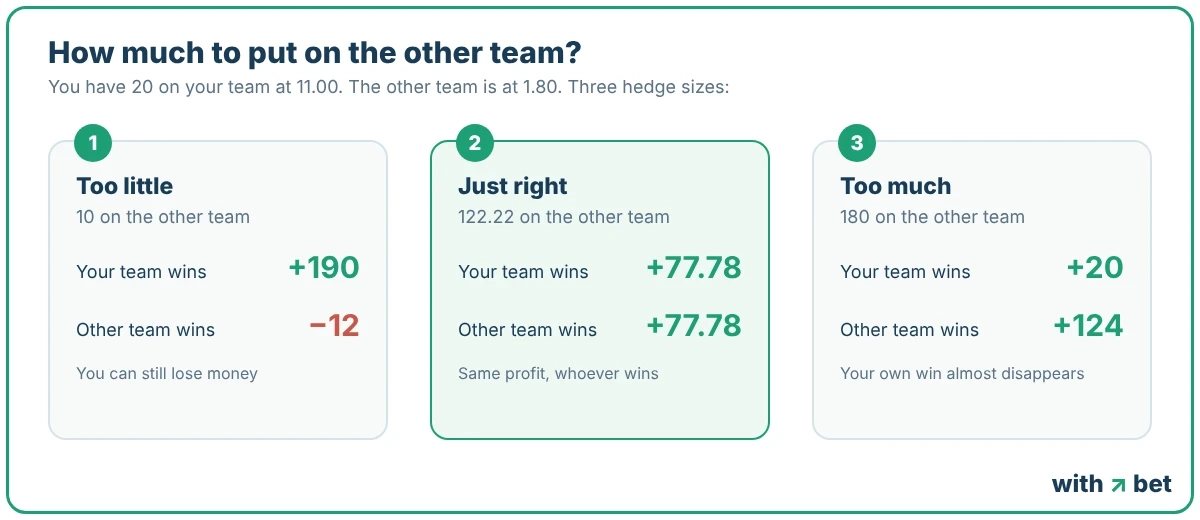
A hedge bet calculator finds that amount for you. For the same profit either way, the rule is short: divide what your first bet can pay by the hedge odds. Here that is 220 / 1.80 = 122.22.
How to use the hedge calculator
Fill in four things, top to bottom.
- Your stake and your odds: the bet you already have, as it says on your bet slip.
- Can it end in a draw? Pick “No, 2 results” for a cup winner, a tennis match or any market with no draw. Pick “Yes, 1X2” for a football match result.
- What do you want? “Same profit”, “Money back” or “My amount”. The three options are explained below.
- Other side odds: the odds you can get right now against your bet. With a draw, type the draw odds and the other team's odds.
The cash out field is optional. Type in what your bookmaker offers, and you will see which pays more.
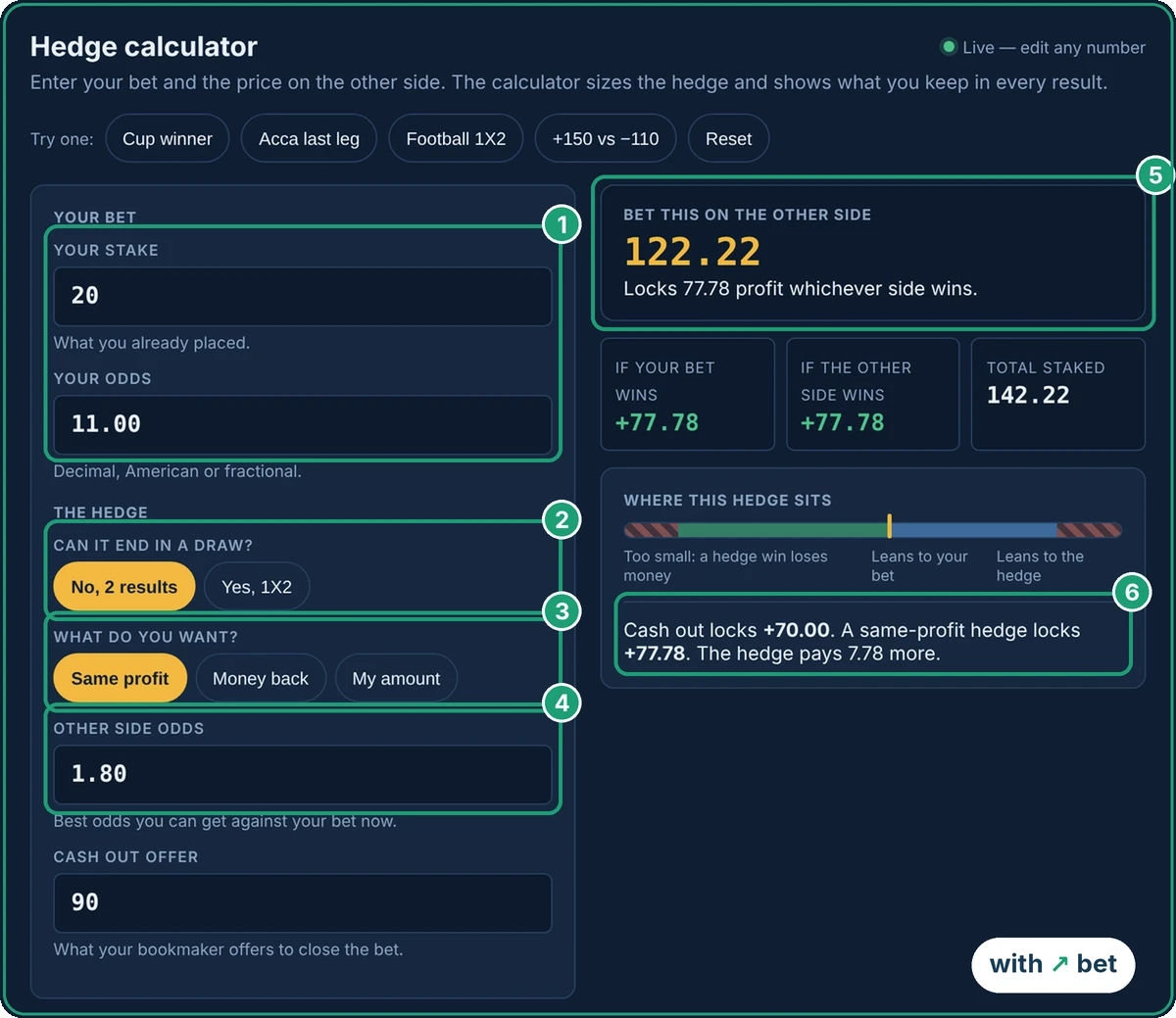
You can type odds as decimal (2.50), American odds (+150 or −110) or fractional (3/2).
Full, break-even or partial hedge
Same profit. This is a full hedge: you win the same in every result. In the cup example, that means 122.22 on the other team and 77.78 profit.
Money back. Maybe you still believe in your team. You only want to stop losing money if they lose. That is a break-even hedge, and it needs much less: 25 at 1.80.
- Your team wins: 220 − 20 − 25 = 175 profit.
- The other team wins: the hedge pays back 45, exactly the 20 + 25 you put in. You end at zero.
My amount. Type any sum you like. This is a partial hedge. With 60 on the other team, you win 140 if your team wins and 28 if it loses. Both are wins, and most of the profit is still on your side.
What the coloured bar shows
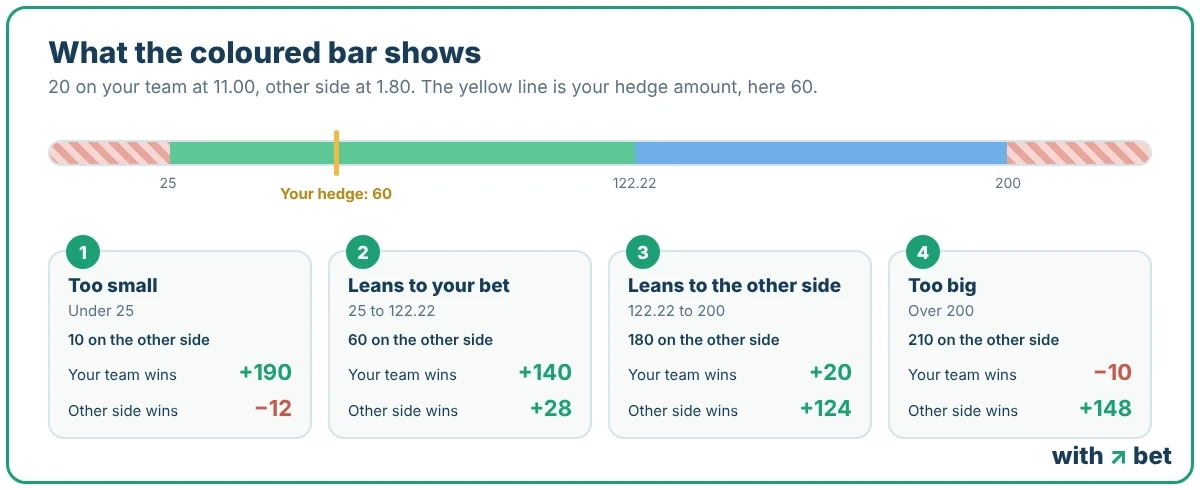
Under the result there is a coloured bar with a yellow line. The yellow line is your hedge amount. The colours show what that amount does to you, from a tiny hedge on the left to a huge one on the right.
Take the cup example again, with 20 on your team at 11.00 and the other side at 1.80.
- Red on the left: too small. Under 25, a win by the other side still costs you money. With 10 on them, you get +190 if your team wins but −12 if it loses.
- Green: leans to your bet. Above 25 and up to 122.22 you win in every result, and most of the profit sits on your team. With 60, it is +140 or +28.
- Blue: leans to the other side. Between 122.22 and 200 you still win either way, but now the bigger win comes if your team loses. With 180, it is +20 or +124.
- Red on the right: too big. Over 200, your own win turns into a loss. With 210, you lose 10 if your team wins the final.
The border between green and blue is the same-profit hedge, 122.22 here. The bar moves as you type, so you can watch the yellow line cross from one colour to the next.
On a phone the bar is hidden to save space. The two results under the hedge stake tell you the same thing in numbers.
Hedging a futures bet
The cup example is a futures bet: a bet on something decided weeks or months later, like a league title or a tournament winner. Futures pay long odds, so they are the classic case for hedging.
Should you hedge the semi-final or wait for the final? The calculator is built for the last match, the one that decides your bet. If you hedge a semi-final, the “your team wins” line is only true if they also win the final. Many bettors wait for the final, when one match is all that is left.
Hedging the last leg of a parlay
An accumulator (in the US, a parlay) is one bet on several matches, and all of them must win. The last leg is a common place to hedge.
You put 10 on five matches at total odds of 13.00. Four have already won. If the fifth one wins too, you collect 130. The other side of that last match is at 2.20.
Type 10, 13.00 and 2.20. The answer is 59.09 on the other side, which leaves you 60.91 up however the last match ends.
If that last match is football and a draw is possible, pick “Yes, 1X2”.
3-way hedge: football and the draw
In football you can win, lose or draw. So if you backed one team, you need two hedge bets: one on the draw and one on the other team.
Say you put 50 on the home team at 3.40. Your bet can pay 170. Since you bet, the home team has become the favourite. Before kick-off, the draw is at 4.20 and the away win at 6.50.
Pick “Yes, 1X2” and type the draw odds and the other team's odds. You get two hedge stakes, 40.48 on the draw and 26.15 on the away team. Whatever the score, you keep 53.37.
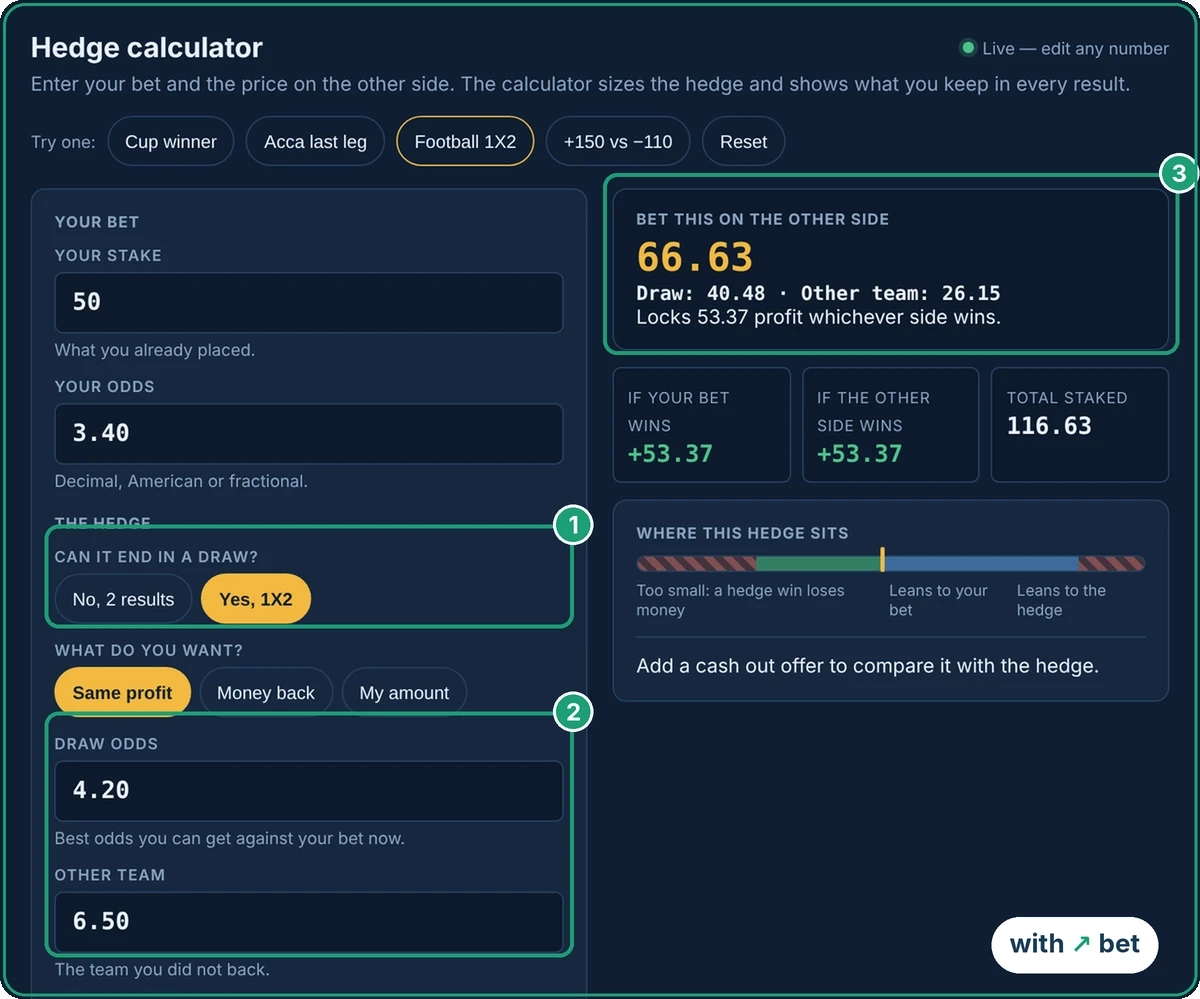
Some bookmakers sell this cover as one bet, called double chance (X2: draw or away win). Our two bets work like one bet at 2.55. If the double chance odds are lower than that, the two separate bets pay you more.
Live hedging during a match
You can also hedge while the match is on. Bettors call it live or in-play hedging.
Say your team scores first. The odds on the other side jump up, and a hedge now costs less. The sums are the same: type the live odds into the calculator.
The catch is speed. Live odds change every few seconds, and the bookmaker can pause betting after a goal or a red card. Type the odds you actually see on the bet slip, then place the bet straight away.
Hedge or cash out?
Many bookmakers show a cash out button next to your bet. It closes the bet early and pays you a fixed amount. In fact, that is a hedge too, with the price set by the bookmaker.
So which pays more? Go back to the cup. Say the bookmaker offers 90 to close the bet now. You staked 20, so that is 70 profit. The hedge at 1.80 gives 77.78, which is 7.78 more.
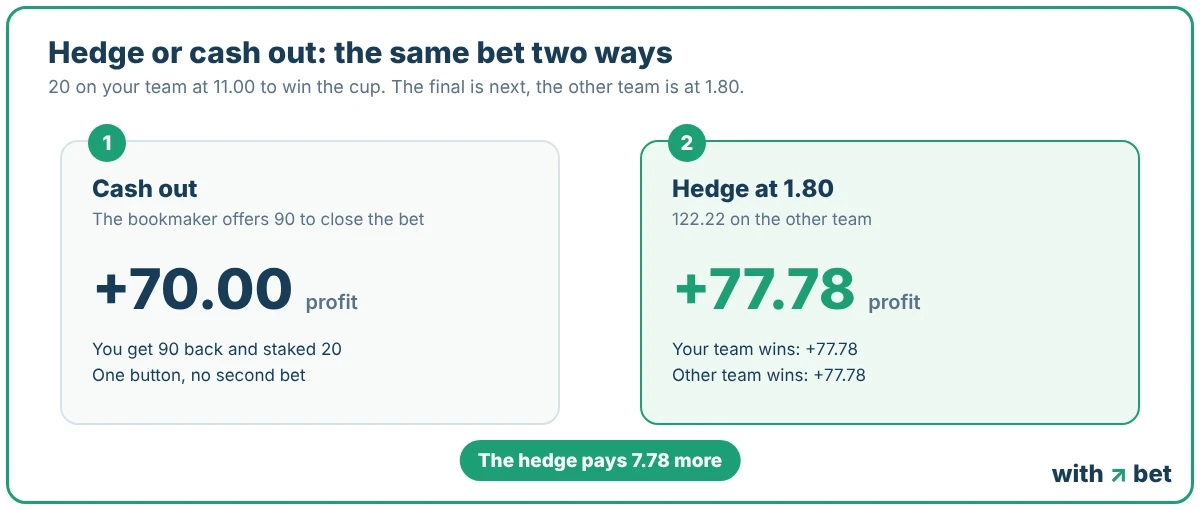
Type the cash out offer into the hedge calculator, and it does this check for you.
Cash out still makes sense sometimes. The hedge may need an account at another bookmaker, a new deposit and a few minutes of time. If the difference is small, one button can be worth it.
The cost of hedging a bet
A hedge is a normal bet, and bookmakers take a small cut from every bet, called the margin or vig. On main markets that cut is around 5% of what you stake, and on futures and live bets it is often higher. On a hedge of 122.22, 5% costs you about 6 over the long run.
Think of a hedge as insurance: you pay a little to remove the risk. If you were sure your team would win the final, the hedge just hands some of your profit to the bookmaker.
One more thing: odds move fast, especially just before a match and during it. Check the hedge odds again right before you bet. If they changed, change them in the calculator too.
Sometimes the odds on the other side are too low to win in every result. The calculator then tells you how much each result would lose, so you know a full hedge is not worth it.
Hedging with American and fractional odds
Bookmakers in the US show moneyline odds like +150 and −110. You can type them as they are, and they are turned into decimal odds first.
Say you have 100 on a team at +150. That bet can pay 250. The other side is at −110. The hedge comes out at 130.95, and you win 19.05 either way.
Fractional odds work the same way: 3/2 becomes 2.50, and 1/2 becomes 1.50.
Want to see what an odds format means? Our odds converter shows the same price in five formats.
Hedging and arbitrage betting
A same-profit hedge is the same maths as a surebet, also called arbitrage betting, just done later. With a surebet, you place both bets at the same time, at two bookmakers, before the match. With a hedge, the first bet is already in and you add the second one later.
To split money across two bookmakers from the start, use our surebet calculator. To check if the odds you took were good, read our closing line value guide. Every calculator we have is in the betting calculators hub.
Frequently asked questions
How do you calculate a hedge bet?
Is hedging a bet worth it?
Can you hedge a bet at the same bookmaker?
Is a cash out the same as a hedge?