Inside a surebet scanner: feed, row, stake
A surebet scanner is software that reads the odds at every bookmaker it follows and lists every market where the best prices on all outcomes add up to less than 100%. Each line in that list is a row. This guide follows the row from the feed to your stake, on the five scanners we hold accounts at.
Pros
- Every step shown on real scanner screens
- Four ways a row can be wrong, with how to spot each
- Free-account table says what each scanner hides
- First-day checklist
Cons
- No paid feed tested
- Scan speeds are the vendors' figures
- Interfaces change; screens are from one week
What a surebet scanner does: collect, match, normalise, calculate
Every scanner runs the same four steps, and the differences between products are how well each step is done.
First it collects. A scanner pulls odds from each bookmaker's site or data feed every few seconds; the vendors quote anything from under a second to fifteen.
Second it matches: “Man Utd v Arsenal” at one book and “Manchester United – Arsenal FC” at another are the same event, and the scanner has to know that before it can compare them. Third it normalises. Every bookmaker names and lays out its markets differently, so the scanner converts them into one shape, so that “Asian handicap −1” at one book lines up with “AH1 (−1)” at another. Fourth it calculates: for every outcome of every market, it takes the best odds across all the books and checks whether the combined price beats 100%.
When it does, a row appears. When one of the four steps goes wrong, a row appears anyway, and that is where most of the money in this category is lost.
The scanner is a matching machine with a calculator on the end. The calculator is the easy part.
The arbitrage maths behind a scanner row
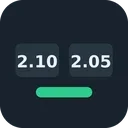
Odds are probabilities upside down. Divide 1 by the odds and you get the chance the bookmaker is pricing in — this is called the implied probability. A price of 2.10 says the bookmaker rates that outcome at 1 ÷ 2.10, or 47.6%. A price of 2.05 on the other side says 48.8%. Add them: 96.4%. If one bookmaker priced both sides, they would add up to more than 100% — the extra is its margin. When two bookmakers together add up to less than 100%, that is an arbitrage, and 100 ÷ 96.4 gives the return, 1.0373, so the profit is 3.73% of whatever you stake.
That percentage is the first column of every scanner row, and it is the only number the scanner is certain of. Everything to the right — which bookmaker, which market, how much to stake — is either a fact from the feed or a suggestion.
Under 100% combined is a surebet. The further under, the bigger the row; past about 5%, the likelier it is a mistake.
How to read a surebet scanner row
The layout differs, the columns do not. Every row in every scanner on this page carries the same seven things.
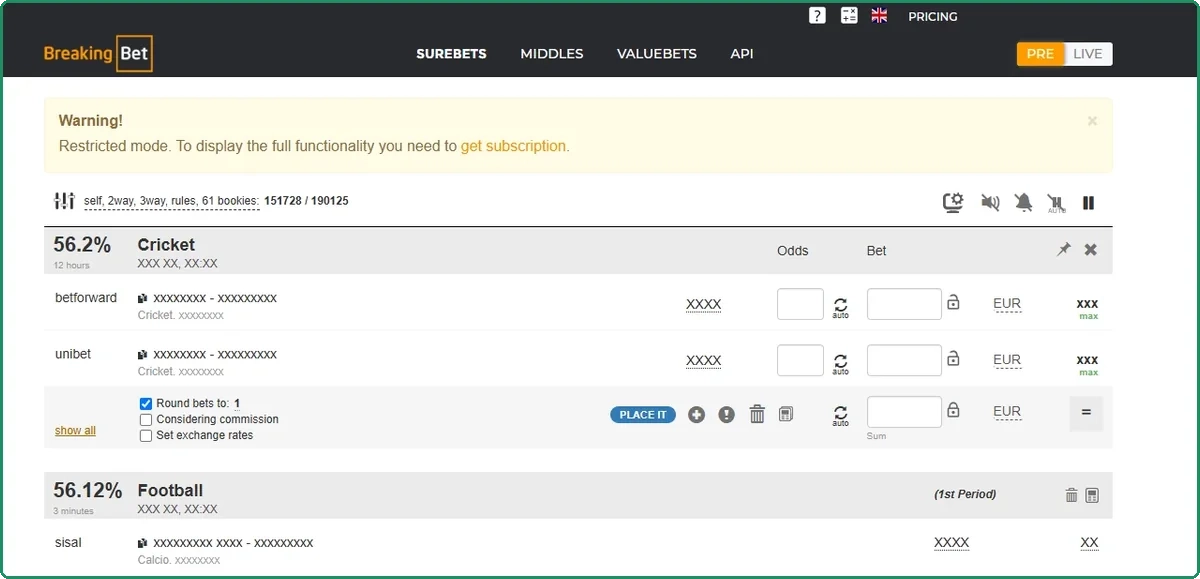
The profit percentage, calculated as above. The age of the row: “a few seconds” is a live row, “12 hours” is a row nobody has taken and probably nobody can. The sport and the market, written the scanner's way (“AH2(+1)” is an Asian handicap on the second team, “Under 3.5” a totals bet, “1st Period” a bet on part of the match only).
One line per bet, each with its bookmaker, its outcome and its odds. The stake for each bet, as a share of a total you set. At some bookmakers, the maximum stake on that market — Surebet shows it under Pinnacle's odds as a stake limit — and where it appears it is worth more than any other column: an arb you can only put €10 on is not worth the click. And two or three icons: open the bookmaker, hide the row, open the calculator.
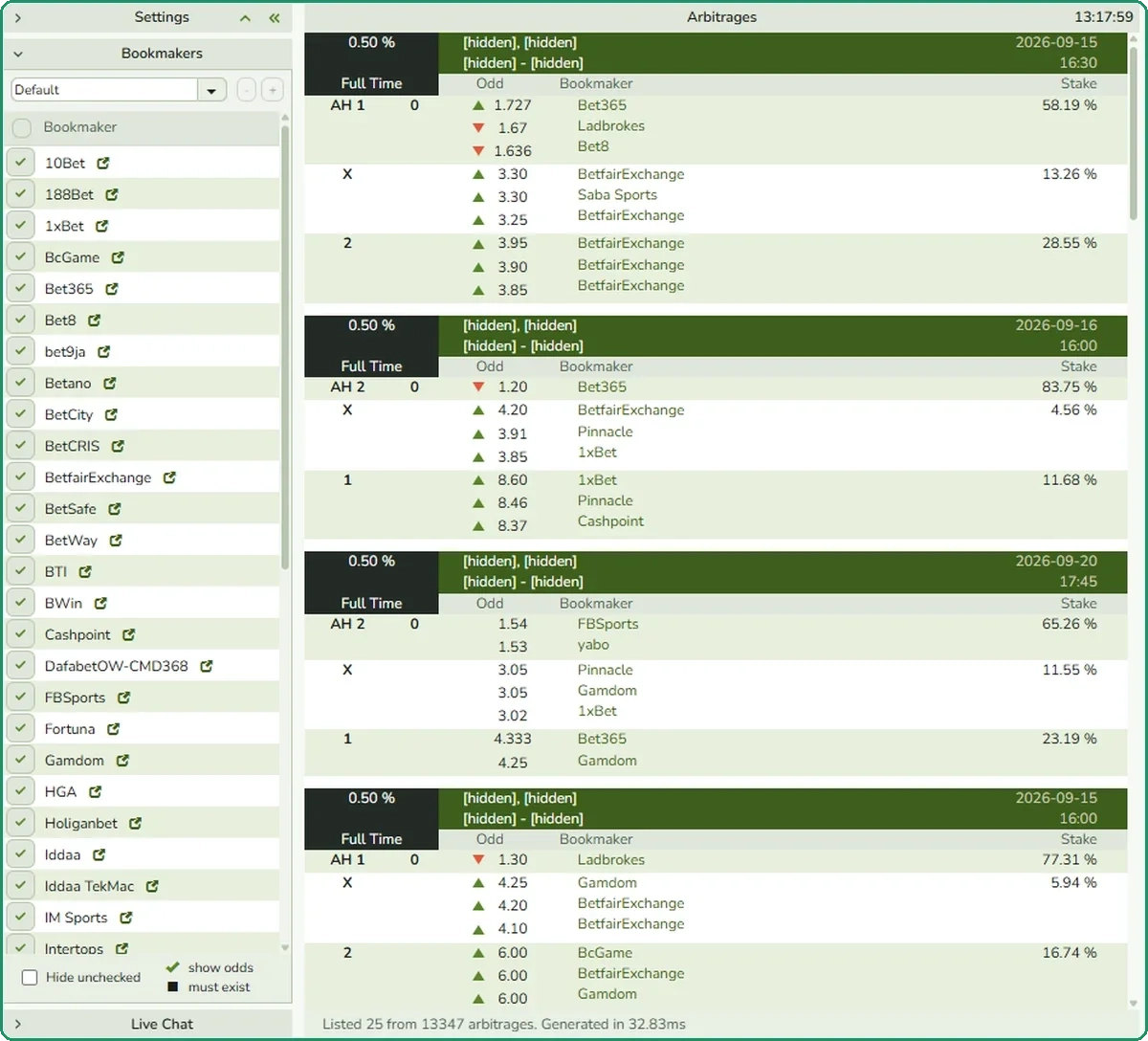
Surebet adds a running count of surebets found; OddStorm shows three bookmakers per outcome so you can see the second-best price; BreakingBet groups rows under the sport and lets you “show all” the variants. None of that changes what the row means.
Why scanners show fake surebets: four failure types
The four steps above fail in four ways, and each produces a row that looks like money.
Matching fails when two events are paired that are not the same: a reserve team against the first team, a women's match against the men's, a tennis qualifier against the main draw. The percentage will be enormous, 20% and up, which is how you recognise it. Normalising fails when two markets are paired that do not cover each other: a handicap at one book measured in games, at another in sets. The row is real and the bets do not add up.
Collecting fails when the odds are stale. A bookmaker changed its price ten seconds ago and the scanner has not been back yet; the row shows a gap that closed before you saw it. This is the ordinary failure, the one subscribers of every scanner complain about, and it is the reason refresh rate is the number scanners argue about.
And the row can be right while the bet is wrong: the bookmaker's price was a genuine mistake, a “palpable error” in its terms (an obvious mistake the terms let it cancel), and it voids the bet after the match starts. You are left holding the other side at full risk. Scanners cannot see this; only the percentage hints at it.
A 56% surebet twelve hours old is not an opportunity. It is a mistake nobody has corrected because nobody can bet on it.
Why “390+ bookmakers” means 62 brands
Bookmaker counts on scanner sites are inflated by design, and the filter shows how.
Open the bookmaker list and the entries are nested: a parent brand with a checkbox, and under it the same brand in other countries and under other names. betPawa Nigeria, betPawa Kenya and eleven more sit under betPawa; 1xBet's mirrors and its sister brands sit under 1xBet; Pinnacle appears twelve times under one parent, as regional sites and as odds sold under other brand names.
The scanner scans them separately because the odds differ by a few points between regions, which is itself a source of arbs. The headline count adds every entry.
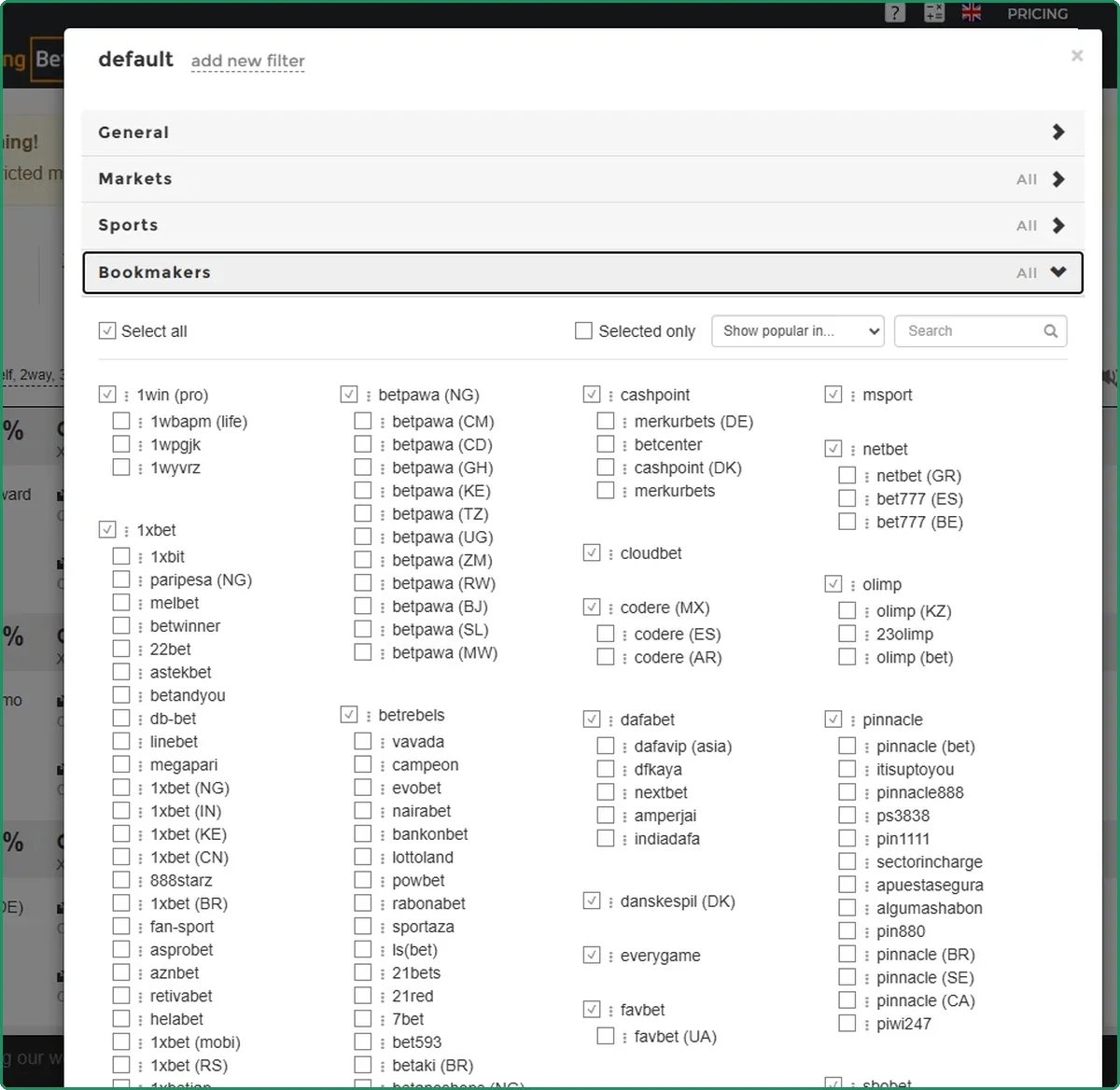
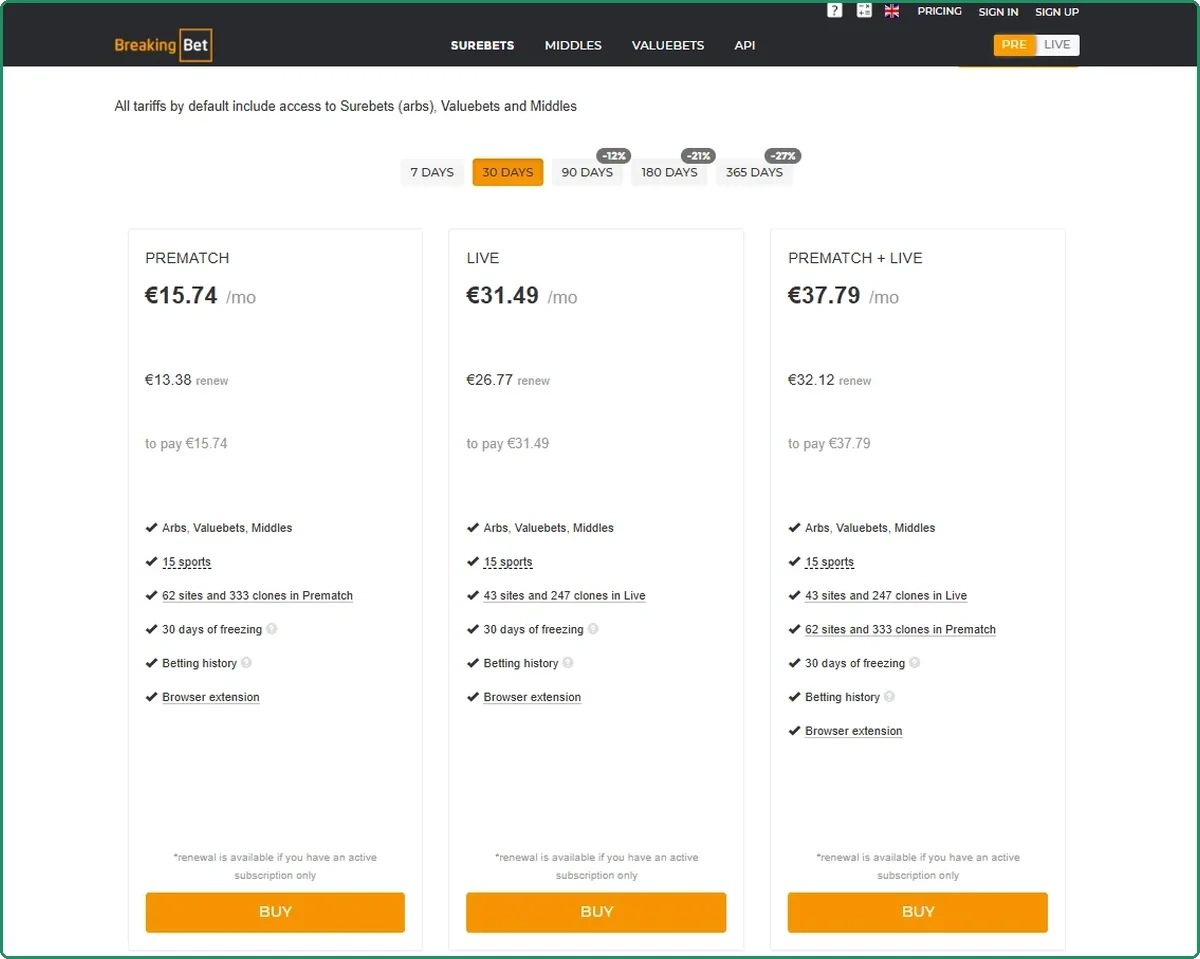
So BreakingBet's “390+ sites” on the plan page is 62 brands plus 333 clones. Surebet's filter opens on a “Popular” preset of 420 and “Show all” gives 1,076, counting Betsson six times. The number that matters is how many of the parents you could open an account with from your country, and only the filter, opened from your own account, tells you that. The five-scanner comparison sorts the lists by region.
Scanner filters: how to match the feed to your accounts
A raw feed lists every row at every bookmaker, most of which you cannot bet at. The filter is where the scanner becomes yours, and it is worth an hour before the first bet.
Every scanner on this page offers the same controls under different names. A minimum and maximum profit: the minimum so the feed is not full of 0.3% rows that vanish before you finish the calculation, the maximum so the matching errors above drop out. A window to kick-off, because a row for a match in three days will move before you get there. The age of the row.
The markets, where three-way arbs need a third account and totals behave differently from handicaps. And the bookmakers, where the setting that matters is “required”: show only rows that include at least one of the books you hold.
Filter sets are saved, but how many you may keep depends on the plan. Surebet allows 2 sets on Free, 8 on Basic and 32 on Max; RebelBetting's trial has no custom filters at all and Starter has 2; OddStorm and BreakingBet keep named sets in the sidebar on every account. Where the free account lets you build one, do it before you read a single row; it stays when you pay.
An hour on the filter is worth more than a month of subscription. The feed nobody filtered is the feed nobody can bet.
The surebet calculator: stake split, rounding, lock, commission
Every row opens into a calculator, and the calculator does one sum. The bet with the lower odds gets the bigger share, so that both return the same amount: for a total stake T and odds a and b, the first bet gets T × (1/a) ÷ (1/a + 1/b), and the rest goes on the second. On the 2.10 / 2.05 pair above and €200, that is €98.80 and €101.20, both returning €207.47. The full worked split, and a calculator that runs it without an account, is on our surebet calculator page.
Nobody bets €98.80. The “round” setting rounds each stake to the nearest 1, 5 or 10, and the profit stops being equal on both sides: €99 and €101 return €207.90 or €207.05, so €7.05 to €7.90 depending on who wins. Rounding is not cosmetic; bookmakers notice stakes to the cent, and the scanners' own help pages say so.
Three more controls appear on most calculators. A lock, which fixes one stake (because a bookmaker limited you to €50) and recalculates the other. A commission box, for bets on a betting exchange, where a percentage of winnings is taken as a fee. And exchange rates, when the two bookmakers hold your money in different currencies and the scanner has to convert before it splits.
Rounding is not cosmetic. €98.80 on one side and €101.20 on the other is a stake only a scanner would write.
From row to bet: links, extensions, auto-navigation
The row is only useful if you can act on it, and the scanners differ most in how they get you from the row to the bet.
The basic version is a link that opens the bookmaker's site, sometimes at the event, sometimes at the sport, sometimes at the home page with the event name in your clipboard. BetBurger's “direct link” and Surebet's “SureBetSlip” aim for the event. BreakingBet's OddsClicker is a browser extension that opens the page and fills the bet in; OddStorm's Auto-Navigation on its Elite plan opens the event and arms the betslip for a limited list of bookmakers. RebelBetting opens the bookmaker and leaves the rest to you.
Every extra bit of automation saves seconds and adds a way to fail. Extensions break when bookmakers change their pages, which they do often, and a filled slip that has not been checked against the live price is how stale-odds rows become losing bets. Whatever the tool, the last step is the same: look at the odds on the bookmaker's screen before you confirm.
The last step never changes: read the odds on the bookmaker's screen before you confirm. No extension does that for you.
Trackers, alerts, negative arbs and the API
Around the feed sit four tools that scanners use to hold subscribers.
The tracker logs bets from the calculator and reports profit, return on the money staked, and how much is currently sitting in open bets at each bookmaker; BetBurger calls it Accounting, BreakingBet Bookkeeping, RebelBetting BetTracker, where it is also the only evidence the profit guarantee accepts.
Alerts push a sound, a browser notification or a Telegram message when a row above a threshold appears, which matters in live and not much in prematch. Negative arbs, rows that lose 1% to 3% by design, are in most feeds for people working through bonus wagering, where a small guaranteed loss is cheaper than the alternative. And the API sells the raw rows to anyone who would rather write their own filter: BetBurger prices it on a page of its own, Surebet includes an XML feed on paid plans, BreakingBet lists it as a tab in the profile.
Live vs prematch surebet scanners
The same scanner runs two feeds with different economics.
In prematch, a row lives for minutes. Bookmakers update their lines on a schedule, arbs come from one book being slow to follow the market, and a fifteen-second refresh loses little. In live, a row lives for seconds, because every goal and every point moves every line at once.
OddStorm's whole argument is that one to three seconds a scan is worth €190 a month in live football; BreakingBet's live feed at €31.49 is the counter-argument, and the number nobody agrees on is exactly how many seconds it takes.
For a first scanner, prematch is where to start. The rows are readable, the maths has time to be checked, and the mistakes cost less.
What the free accounts actually show
Every scanner on this page has a free account or a trial, and each one hides something different. The table decides where the first evening can be spent.
| Scanner | Free access | What you see | What is hidden |
|---|---|---|---|
| BetBurger | Free forever, no card | Value bets to about 2% with real matches | The surebet feed |
| RebelBetting | 14-day trial, no card | Sure bets to 2%, value bets to 5%, real matches | Everything above the caps, custom filters |
| Surebet | Free plan | Matches, odds, bookmakers, stake limits | Surebets above 1%, positive middles |
| OddStorm | Free account; separate 7-day Pro trial with a card | Percentage, odds, bookmakers, stake split | Team names |
| BreakingBet | Restricted mode, no card | Percentage, sport, market, bookmakers | Team names and odds |
So an evening of reading the feed teaches different things on different scanners. Surebet is the only free account where a row can be read end to end and a 40% matching error recognised by its teams. OddStorm and BreakingBet show which bookmakers keep appearing and how long rows live, but not whether the pairing is right. BetBurger's free account says nothing about its surebet feed at all.
How to use a surebet scanner: the first day
- Register. A name, an email and a password everywhere; a card only for OddStorm's paid trial, which converts to €290 on day 8 unless cancelled.
- Set the timezone. BreakingBet defaults to UTC and makes every kick-off time wrong until you change it; check the setting on the others too.
- Set a default stake for the calculator to split, and a default currency.
- Build the filter above — profit range, kick-off window, markets, required bookmakers — and save it where the plan allows.
- Read the feed for an evening without betting. Count how long rows live, which bookmakers keep appearing and, where the teams are visible, how many of the big percentages are matching errors.
- Answer one question: does the scanner's bookmaker list overlap the accounts you already hold? That is the only question that decides whether to pay for it.
What a scanner will never do
It will not place the bet. It will not tell you whether the bookmaker will accept your stake: the stake-limit column, where it exists, shows the limit the bookmaker publishes, not the one it will apply to your account tomorrow. It will not know that the price was a mistake until the bookmaker voids it. It will not stop your accounts being limited, and the scanners' own help pages on delaying limits — round stakes, ordinary odds, plain bets in between — describe delay, not prevention.
What it will do is read from sixty to several hundred bookmakers every few seconds and write down where they disagree. For a beginner, that is the whole of how to use a surebet scanner: set the filter, read the row, check the odds at the bookmaker, then bet. On a 30-day plan that costs from €0.52 a day for a prematch feed to €9.33 a day for the most expensive live one, and the comparison says which price buys what.
Frequently asked questions
How does a surebet scanner find arbitrage bets?
Why does a scanner show a 50% surebet?
Do surebet scanners place bets automatically?
Is there a free surebet scanner?