Accumulator calculator: what your acca pays
Enter your stake and the odds of every leg. This parlay calculator multiplies them, shows the payout and profit, and handles void legs, Asian half wins and free bets.

Pros
- Three odds formats in one field
- Asian half wins and half losses
- Free bet and profit boost modes
- Shows the chance of landing
Cons
- No system bets like Trixie
- No each-way or place legs
- Overstates same game parlay payouts
- Does not track live odds
Parlay calculator
Live: edit any numberEnter your stake and the odds of each leg. Decimal (1.80), American (-110) and fractional (4/5) all work.
Leave each leg on "Pending" before the games. After a game, set Won, Lost, Void or a half result.
Every leg must win. A void leg counts as odds of 1.00 and drops out. The chance shown includes the bookmaker's margin, so the real chance is usually a little lower.
Parlay, accumulator, multi: one bet
A parlay is one bet on several matches. You win only if every pick wins. If even one loses, the whole bet is lost.
The name depends on the country. In the US it is a parlay. In the UK and most of Europe it is an accumulator, or acca for short. In Australia it is a multi, and some bookmakers say combo. So a parlay calculator and an acca calculator do exactly the same job. Each pick inside a parlay is called a leg. Two legs make a double, three make a treble. In the US, one parlay can mix a moneyline bet (who wins), a point spread and a total.
People like parlays because the odds of all legs are multiplied, and a small stake can win a lot.
How to use the parlay calculator
- Type how much you bet next to “Stake”.
- Type the odds of each leg. Any format works: 1.80, -110 or 4/5.
- Before the games, leave each leg on “Pending”. After a game, choose what happened: “Won”, “Lost”, “Void”, “Half won” or “Half lost”.
- Look at the big yellow number. That is the money you get back.
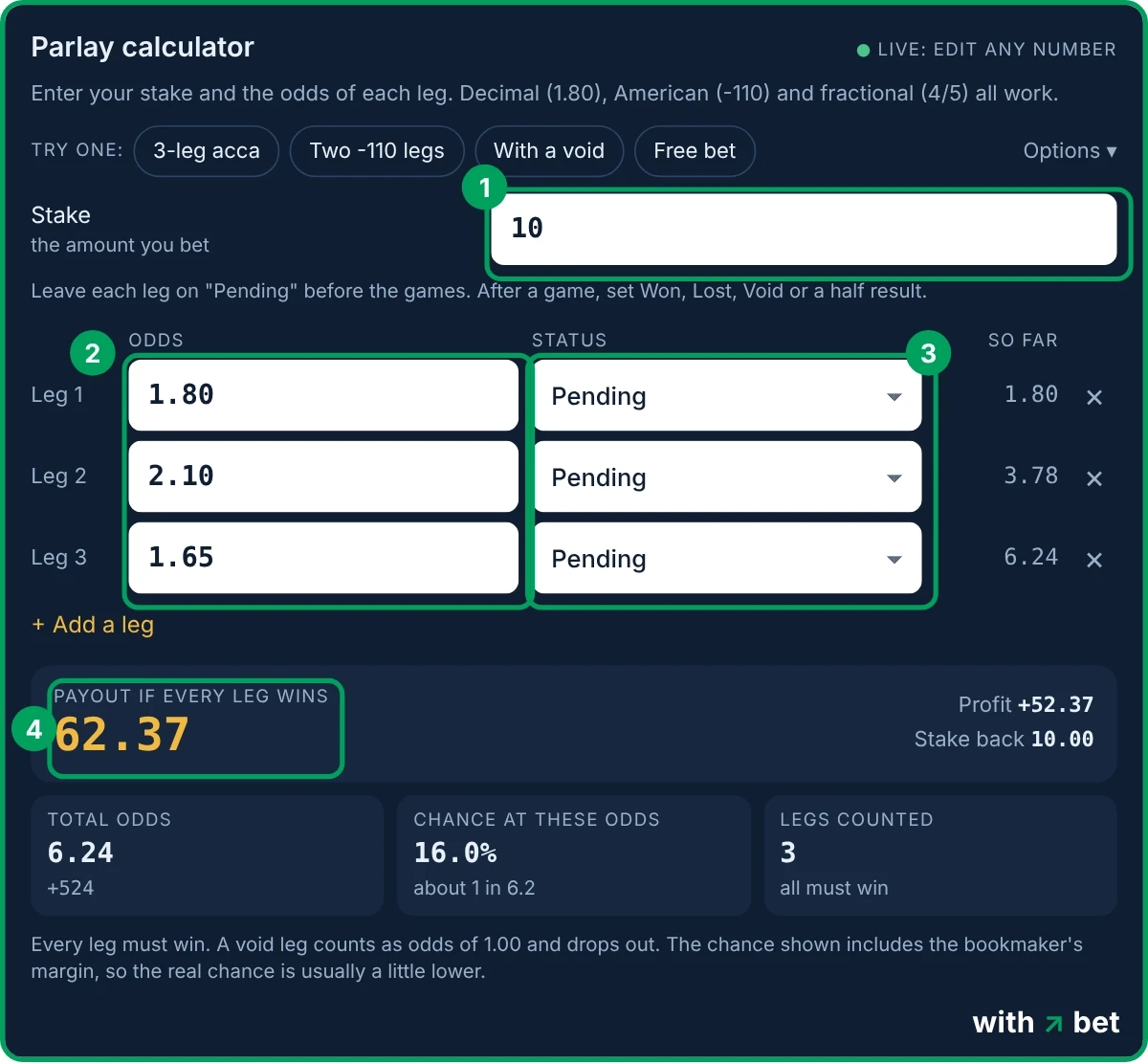
Say you bet 10 on three legs at 1.80, 2.10 and 1.65. The calculator shows 62.37: that is what you get if all three win.
More legs? Press "+ Add a leg". You can add up to 12.
How parlay odds are calculated
Multiply the odds of all legs: 1.80 × 2.10 × 1.65 = 6.237. These are the parlay odds, also called the combined odds or total odds. Now multiply by your stake: 10 × 6.237 = 62.37.
US bookmakers write odds differently, for example -110. That is the usual price on a point spread or a total. The calculator turns -110 into decimal odds for you. Two legs at -110 with a stake of 100 pay back 364.46.
Need to convert just one price? Our odds converter does it.
Parlay payout, profit and stake
The payout is all the money you get back, and your stake is part of it.
In our example you get 62.37. Of that, 10 is your own money coming back, so your profit is 52.37.
Bookmakers often call the payout “potential return”. US sites often show only the profit and call it “to win”, so the same bet can look smaller there.
Why the chance falls so fast
Every leg that is not void must win. So each new leg makes the whole bet less likely to win.
Imagine a strong pick that wins 7 times out of 10, and put five such picks in one parlay. All five win together only about 17 times out of 100. With ten picks, it is about 3 times out of 100.
The calculator shows this chance under “Chance at these odds”. For our three legs it is 16%, or about 1 bet in 6. Bettors call it the implied probability: the chance hidden inside the odds.
The real chance is usually a bit lower, because the bookmaker keeps a small cut in every price. When you mark some legs as “Won”, the chance only counts the games still to play.
The margin grows with every leg
On a coin toss, fair odds are 2.00: you bet 10 and get 20 back. A bookmaker offers 1.90 instead and keeps the difference. That cut is called the margin, or the vig.
In a parlay that cut is multiplied with every leg. This is what a stake of 10 pays on coin-toss legs:
| Legs | Bookmaker pays at 1.90 | Fair payout at 2.00 | Share of fair payout |
|---|---|---|---|
| 2 | 36.10 | 40.00 | 90% |
| 3 | 68.59 | 80.00 | 86% |
| 5 | 247.61 | 320.00 | 77% |
| 10 | 6,131.07 | 10,240.00 | 60% |
On ten legs you get only about 60% of a fair payout. A 10% “acca boost” sounds generous, but it does not close the gap. On five legs it lifts 247.61 to 271.37, while the fair payout is 320.
So every leg needs to be worth betting on its own. To decide how much to stake, use our Kelly calculator and treat the whole parlay as one bet at its total odds.
Void legs and pushes
Sometimes a leg is cancelled. The match is postponed, a horse does not run (a non-runner), or a handicap ends exactly on the line and the stake is returned. Bookmakers call this a void or a push.
In a normal parlay, a void leg counts as odds of 1.00, and the other legs stay in the bet.
Say three legs at 2.00, 1.75 and 1.90 would pay 66.50 on a stake of 10. Then the 1.75 match is cancelled. Set that leg to “Void”: now only two legs count, and the bet pays 38.00.
Be careful with same game parlays (SGPs), where all legs come from one match. Bookmakers have their own rules for them, and some cancel the whole bet when one leg is void.
Asian handicap legs: half wins
An Asian handicap with a line like -0.25 or -0.75 splits your stake into two halves. So the bet can end with one half winning and the other half coming back, or with one half lost.
Inside a parlay, this changes the total odds:
- “Half won”: half of the money wins, the other half comes back. A leg at 2.10 then counts as 1.55 instead of 2.10.
- “Half lost”: half of the money is lost, the other half comes back. The leg counts as 0.50.
Back to our three legs. The 2.10 leg ends as a half win, so the bet pays 46.04 instead of 62.37. If it ends as a half loss, the bet pays 14.85.
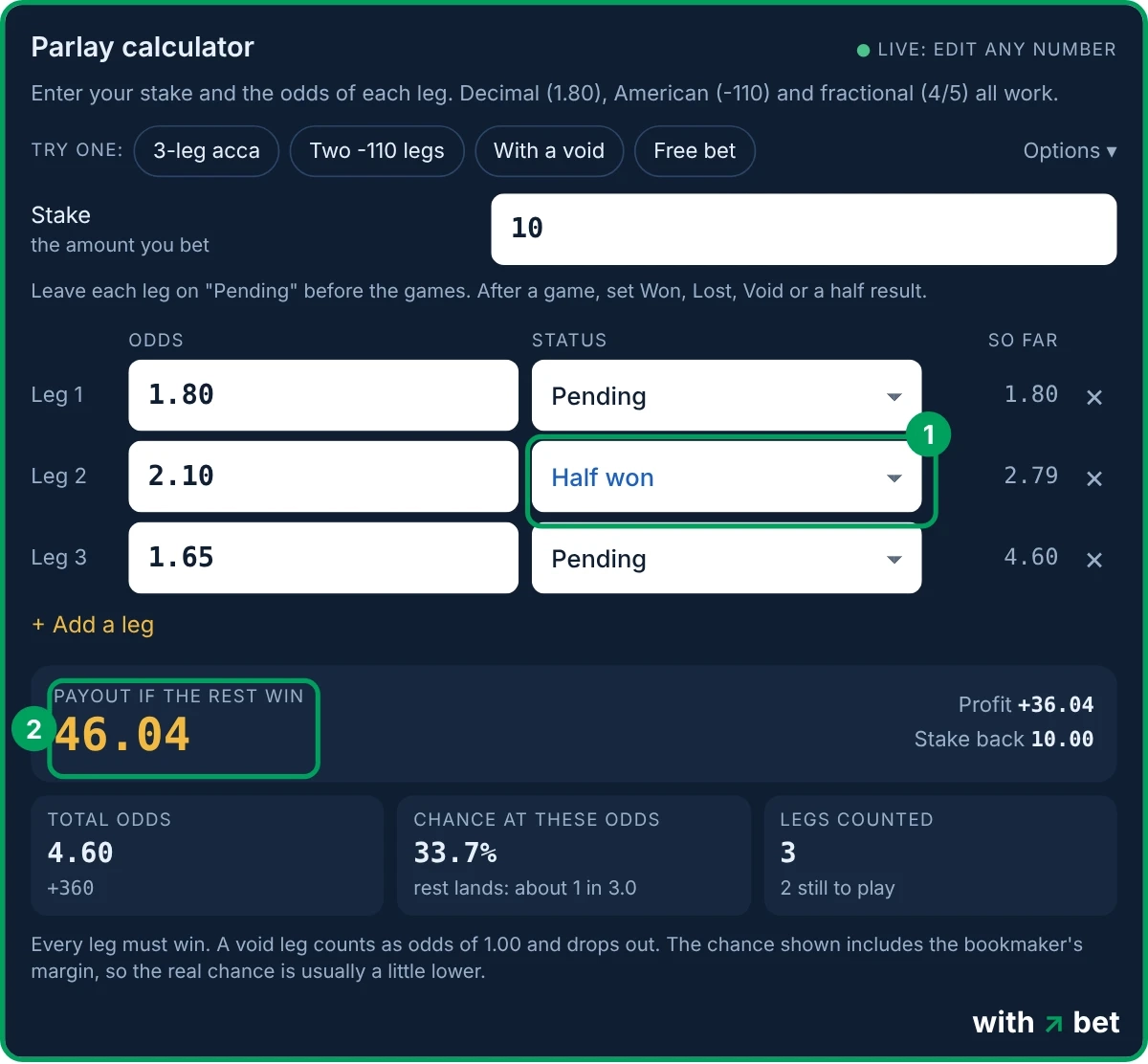
In the calculator, choose “Half won” or “Half lost” and it counts the leg for you. Our Asian handicap calculator explains when a bet ends this way.
Free bets and profit boosts
A free bet is a bet the bookmaker pays for. If it wins, you get the winnings only. The stake itself does not come back.
Say you have a free bet of 10 on two legs at 2.00 and 2.50, so total odds of 5.00. A normal bet would pay 50. The free bet pays 40. To see this, open “Options” and press “Free bet: stake not returned”.
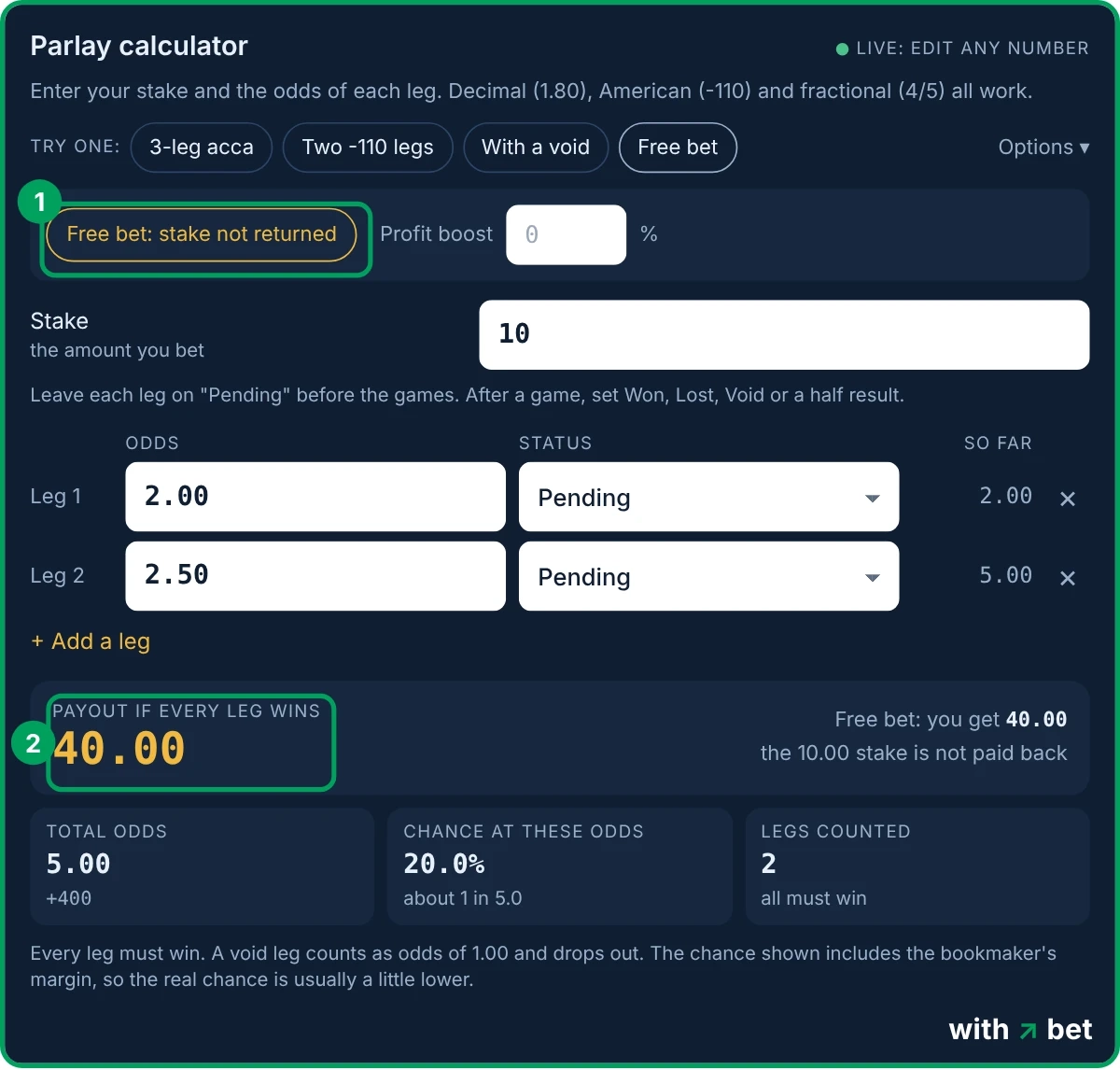
On higher odds the missing stake matters less, so free bets suit longer prices. You will find the free bets we have checked in our bonuses section.
A profit boost adds extra money to your winnings. Type the percent into “Profit boost”. On our three legs, a 20% boost turns 52.37 of profit into 62.84, and you get back 72.84. Some bookmakers boost the odds instead of the profit, and then the number differs a little.
Why your slip may differ
The calculator uses the exact odds. Your bookmaker's bet slip can show a slightly different number. The usual reasons:
- the bookmaker rounds the odds;
- it has a maximum payout for one bet;
- it usually pays less on same game parlays, because their legs depend on each other;
- the odds changed after you checked them;
- you placed a round robin, which is several small parlays at once, while this calculator counts one parlay.
If the slip shows less, check the odds of each leg first. If 2.10 dropped to 2.00, the payout falls from 62.37 to 59.40.
When a parlay is nearly done
Four legs have won and one is left. To keep some money whatever happens, bet on the other side of the last match. That is called a hedge, and our hedge calculator shows how much to stake. Your bookmaker may also offer a cash out, and the hedge often pays a little more.
Frequently asked questions
Is a parlay worth it?
How many legs can a parlay have?
What does +524 mean on a parlay?
What is a round robin?