
Comparing odds on Oddspedia: payout switch and 74% list
An odds comparison site has one job: show the best price for a bet across many bookmakers. Oddspedia does that for free, without an account. Around the grid it runs free betting tools, tipster contests, bonus codes and reviews of the same bookmakers it compares.

Pros
- Free with no account.
- Payout percentage per bookmaker.
- Movement history on every selection.
- Forty-six books on one European qualifier.
Cons
- Four different bookmaker counts across its own pages.
- Hot Bets rows start at 1.05, far below what its own hit rate needs.
- No source given for the value bets probability.
- Promotions are aimed at Britain.
Verdict: 4.0 out of 5. This is a strong free odds comparison site. Just over forty-six bookmakers priced our test match. A payout switch shows the margin inside each market, and every selection keeps its price history. The free tools need more care. The 74% banner on Hot Bets sits over a list that starts at 1.05.
Scope: this Oddspedia review is built from our own use of the site, on a desktop and in a phone browser. We read it on the international version, in decimal odds. Everything described below is free and needs no account.
What Oddspedia is
Oddspedia is a free odds comparison site. It reads live odds from bookmakers and puts them side by side for one match. You compare odds across the row, take the best price, and place the bet at that bookmaker. Oddspedia never holds your stake or your money.
Comparing prices before every bet is called line shopping. A grid like this exists to make that quick. The rest of the site is built around it: live scores, statistics, football tips, betting guides and bookmaker reviews. The company also sells its odds widgets to other websites, which is one clue about where the money comes from.
Who runs Oddspedia, and when it started
Oddspedia is run by Oddspedia JSC, an international betting affiliate. It was co-founded by Jan Möller and Jeton Kodia, who both talk about the company in trade interviews.
The starting year depends on where you read it. The About page on the site says 2013. Both founders say 2014, in separate interviews. A traffic analytics profile lists 2012. The same About page also claims more than twenty years in the industry, which fits none of those years.
The odds are not wrong because of this. But the same pattern runs through the whole site, and the next section is the clearest case of it.
How many bookmakers Oddspedia compares
The company gives four answers. Its odds page says more than seventy. Its widget site says more than 120 in one place and more than 60 in another. The counter at the foot of every page reads 179 bookmakers.
The number that matters is different: how many books price the match in front of you. On a Champions League qualifier we counted the rows one by one and reached 46. That is a strong grid by any measure, and it is not 179.
Competition size does not decide the count. Oddspedia's blocked odds tool prints it on every row. The ones we saw ran from 21 books up to 44, on markets much smaller than that qualifier. Read the home page counter as marketing, then count the rows on your own match.
Four bookmaker counts, all from the same company. The one that matters is the 46 we counted on our own match.
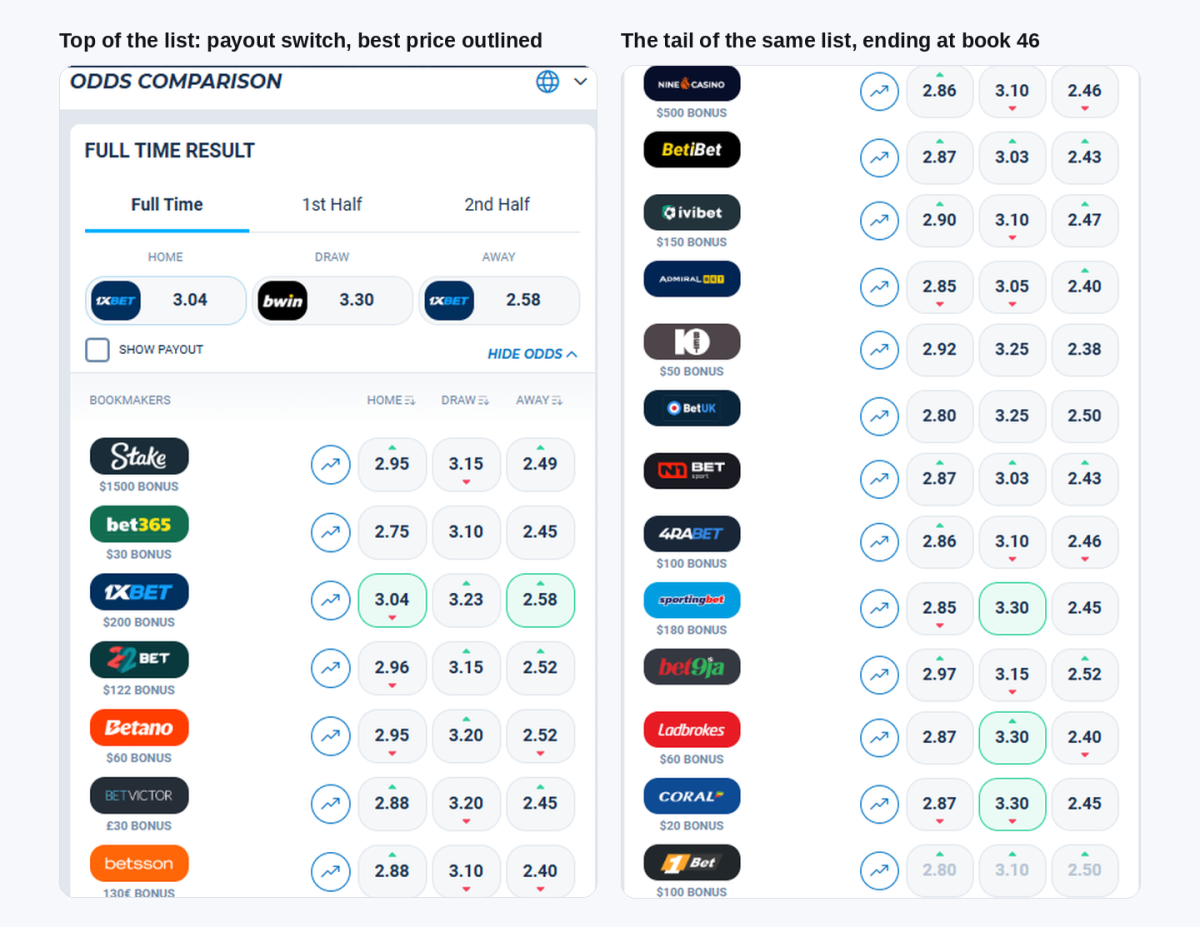
What the odds comparison table shows on one match
Every bookmaker gets a row, with a price for each outcome and a small arrow showing which way that price last moved. The best price in each column is outlined, so the Oddspedia table answers your question in one look.
Two things sit next to those numbers. A payout box can be switched on, which turns the three prices into the percentage the book pays back on that market. On our qualifier the leader paid 97.47%, meaning a margin of 2.53% against the bettor. It decides how much of your stake the bookmaker keeps, and it belongs beside any price. Payout is the same idea as implied probability, read from the bookmaker's side.
Switch the payout box on and the grid stops being a price list. It starts telling you what each bookmaker keeps.
The second thing is advertising. Every logo carries a bonus badge, and the sums are large. The grid and the promotion sit in the same table.
Markets get mixed together, too. FanDuel, DraftKings and BetMGM appear beside bet365, 1xBet, Betano, Marathonbet, Parimatch and Ladbrokes. Betfair is in there as well, so the grid covers a betting exchange and not only bookmakers. Some of these you will never be able to open, depending on where you live.
How to find the best odds on Oddspedia
- Set the country flag to the version you want, then choose your odds format.
- Open the match from the Odds menu, or from the live scores list.
- Pick your market: full time result, totals, or one of the halves.
- Turn on the payout box and see which bookmaker keeps the least.
- Click the best price and take the button through to that bookmaker.
The settings stay saved, so only steps two to five repeat on the next match.
Which Oddspedia country version you get
Oddspedia runs separate versions for the United States, Canada, Germany, Italy, Spain, France, the Netherlands, Brazil, Mexico, Japan, Bulgaria and Russia. It picks one for you when you arrive.
That choice decides a lot. Our first visit landed on the American version, opened from outside every market on that list. The front page led with NFL, MLB and WNBA, and every price was in American odds. Switching the flag to the international version changed both.
So switch the flag before you compare anything, then set your odds format. Our odds converter turns any price back into decimal, fractional or American odds, and into an implied probability.
Using Oddspedia without an account
The Oddspedia grid is open. No sign-up, no email, no card. Click a price and a panel offers the way through to that bookmaker.
A Sign in link exists for the parts that must remember you: a bet slip, saved coupons and the tipster side. For price shopping, none of it is needed. The phone browser gets the full site as well, with a bottom bar for scores, odds, tips and bonuses. There is no Oddspedia app in the stores, and none is needed.
Hot Bets and the 74% hit rate
Hot Bets is the Oddspedia free football tip list, and it advertises a 74% hit rate in its own page title. The method behind it is published. Both teams must have played at least five matches. Their combined success rate in that market must be at least 50%. The markets are goals, corners, cards and both teams to score.
Then look at the prices. A 74% hit rate breaks even at decimal odds of 1.35, because 1 divided by 0.74 is 1.3514. Anything shorter loses money at that rate, however often a tip lands.
Sort the list by odds and it opens at 1.05, then 1.06, 1.07, 1.08, 1.10 and 1.12. A price of 1.05 needs a strike rate of 95.2% to break even. At 1.12 you still need 89.3%.
Those rows are not the weak ones, either. They carry the highest team percentages on the page, which is why the prices are so short. But 74% is the number the tool advertises for itself, and at 74% each of those rows loses money.
At 74% you break even on 1.35. Sorted by price, the list starts at 1.05, and that needs 95.2%.
Oddspedia gives you the fix in the same panel. Its odds filter starts at 1.05, and you can drag that floor up. Set it to 1.35 and the rows that are left can at least pay.
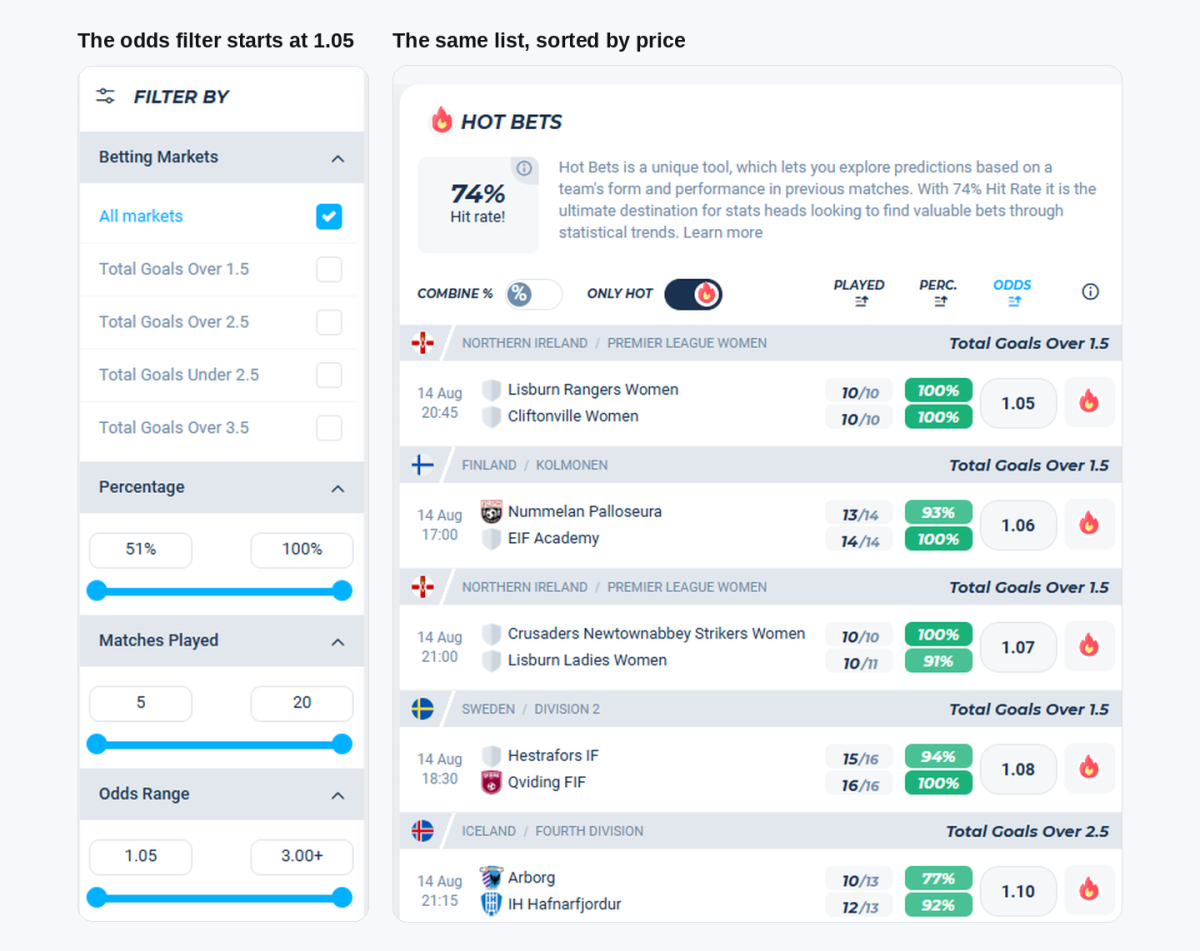
The percentages beside each row are per team, so ten wins in fifteen for both sides prints as 67% twice. The competitions run small as well: Northern Ireland Premier League Women, the Finnish Kolmonen, Sweden Division 2, the Icelandic fourth division. Stakes in those markets are capped low.
Oddspedia sure bets, and the 93% row
A sure bet, also called an arbitrage or a surebet, is a set of prices at different bookmakers. Together they guarantee a profit whatever happens. Oddspedia lists them free, sorted by profit, with a calculator on every row.
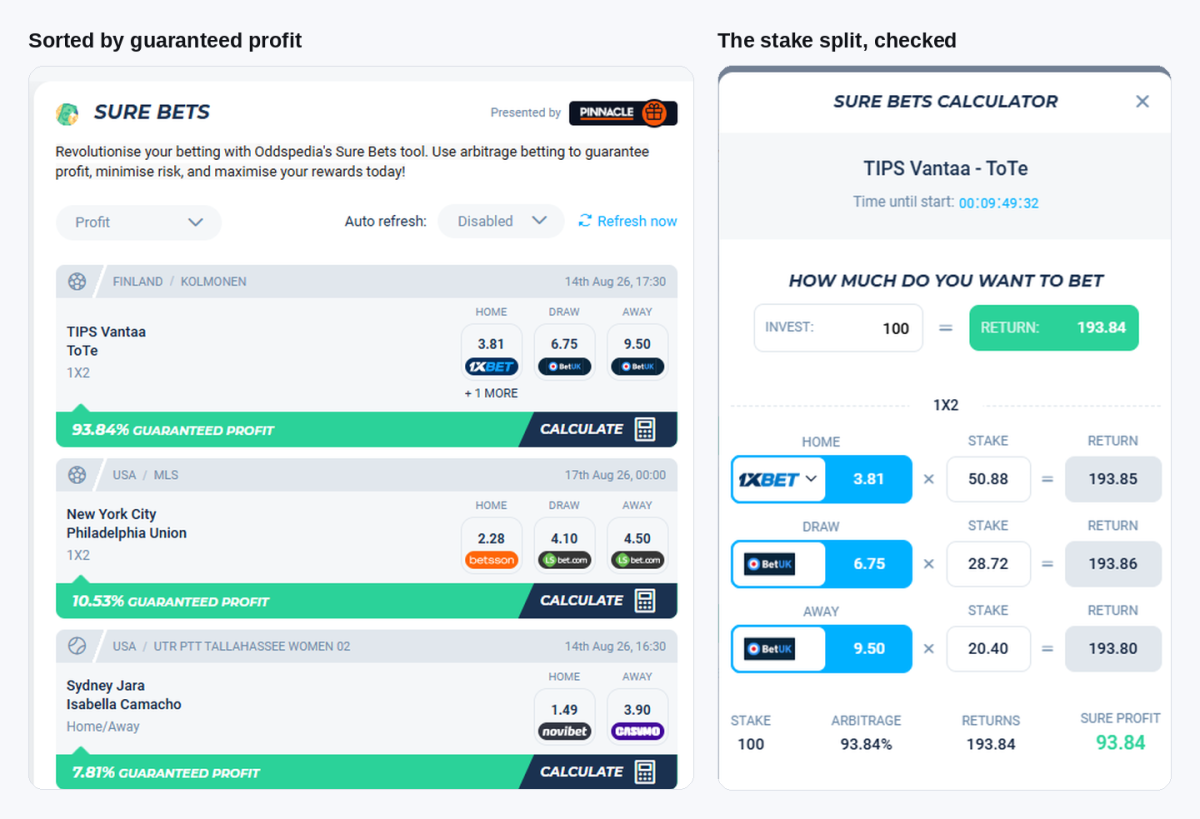
The calculator does its job. On a three-way market it split a 100 stake into 50.88, 28.72 and 20.40 across the three outcomes, each returning about 193.85. We checked all three lines and the arithmetic holds.
The profit figures need more care. The top row of our list promised 93.84%, in a Finnish Kolmonen match. That number is a warning, not an opportunity. A number that size means one bookmaker has mispriced a line. Mispriced lines get voided or cancelled before they get paid. The rows below it were the realistic ones, at 10.53% and 7.81%.
A guaranteed profit of 93.84% is not an opportunity. It is a bookmaker error, and errors get cancelled before they pay.
Auto refresh is off by default, so the list you are reading may be stale unless you press refresh. The calculator will also put two of your three legs at the same bookmaker. That leaves the whole position behind one account.
Dropping odds, and what a falling price means
Dropping odds lists selections whose price has fallen since it opened. A price falls because money has arrived on that side, or because news has reached the bookmaker before it reached you. Late team news moves a line faster than anything else.
The Oddspedia list is free and sits in the same Tools menu as the rest. Read it as a signal about where the market is going, not as a tip. A shortening price tells you what other people think, which is not the same as being right.
Oddspedia value bets, and where the probability comes from
The Oddspedia value bets tool lists prices it judges longer than the true chance. Rows are sorted by an overvalue percentage, and that sum is easy to follow. Multiply the odds by the probability and take away one. A 23.00 price with a stated probability of 8.47% gives 94.8%, and the page prints 94.7%.
What the page never says is where that probability comes from. That is the number the whole list depends on, and it is not sourced anywhere.
The whole value bets list rests on one probability, and the site never says where that probability comes from.
The examples show why that matters. Ours were an Estonian second-tier home win at 23.00, an Icelandic away win at 30.00 and a Chilean basketball draw at 55.00. All three are long shots in markets that almost nobody prices carefully.
Use the list to find candidates, then price them yourself. The site's own advice is to play these as singles, which is sound, but the probability behind them is unexplained.
Blocked odds, and why a market disappears
Oddspedia's blocked odds list shows markets that bookmakers have taken down. It is also the plainest tool on the site. Each row gives the share of books that have pulled the market. The old price is crossed out with the new one beside it.
One tennis market had 40 of 44 books blocked, with the price moving from 2.81 to 2.65. That tells you something real: the market has moved, and a handful of books have not caught up. The page explains what suspension means and why it happens, which the value bets page does not manage for its own numbers.
Odds movement, and the archive behind it
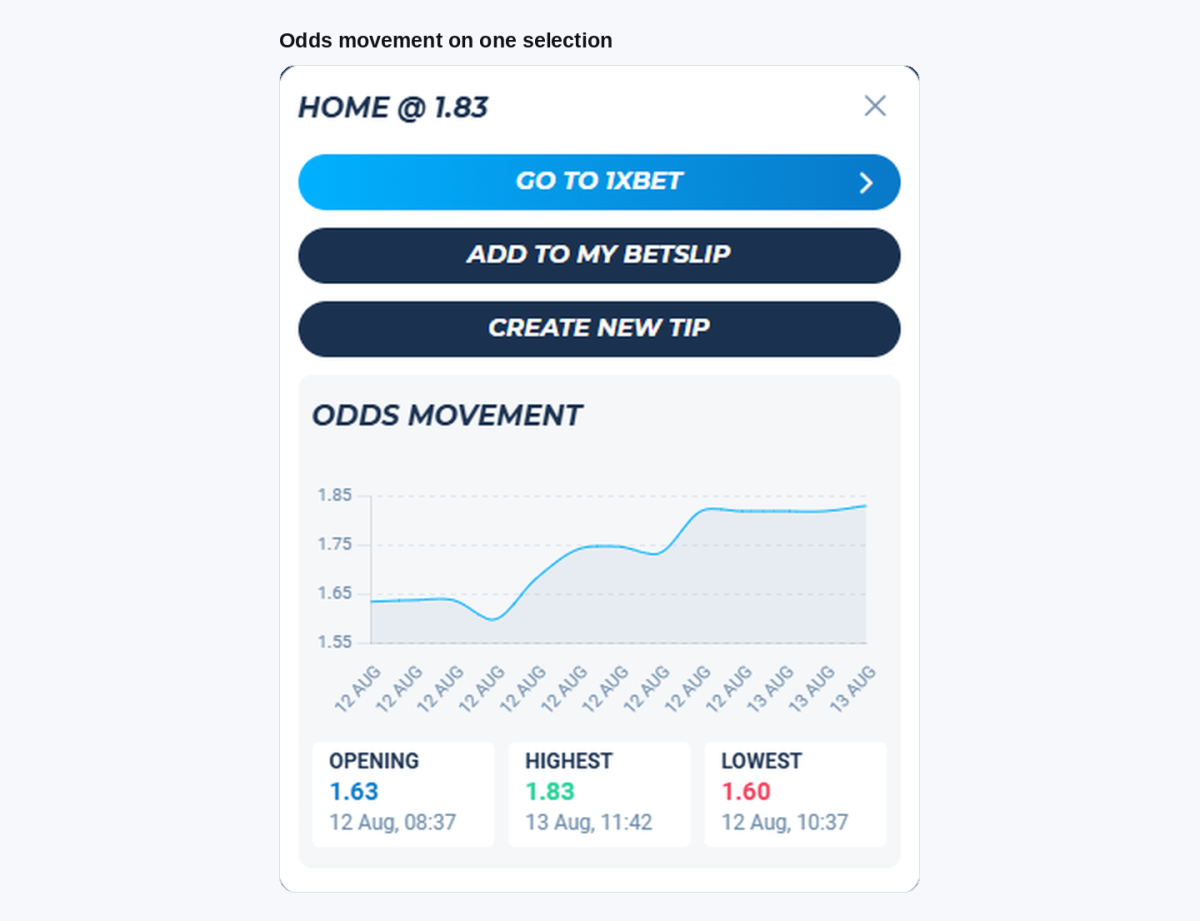
Click any price and a panel opens. It gives you a button through to that bookmaker, a slot in your bet slip, and a shortcut to publish the pick. Under those sits a graph of how the price has moved. Some selections also carry a money percentage, such as 95% of the stakes landing on the home side.
For a serious bettor this part of the site is the most valuable. Closing line value compares the price you took with the price at kick-off. It needs a record of that closing price. Free grids are one of the few places to find one. Our closing line value guide works through the sum.
On one qualifier the graph ran across three days. It opened at 1.63, dipped to 1.60 and reached 1.83, with a date and a time on every point.
The panel has one gap. It labels an opening price, a highest and a lowest, but never a closing one. The history does survive the match, so you can go back for it after the event. A finished tie still read 1.21 at the open, 1.23 at the top and 1.08 at the bottom. The number closing line value needs has to be read off the graph yourself. Our OddsPortal review found a closing price on every selection, which Oddspedia does not label.
Sports and languages covered
The sports bar carries football, tennis, basketball, ice hockey, baseball, American football, volleyball, handball, cricket, darts, table tennis and mixed martial arts. More sit behind a menu, and special bets have their own tab.
Football is the deepest by far, down to fourth and fifth division leagues in small countries. That depth is why the tool lists fill up with matches from Iceland and Finland.
Beside the international English site there are twelve country versions, including German, Spanish, French, Portuguese, Japanese and Bulgarian.
Tips, tipsters and the leaderboard
Oddspedia publishes tips as well as prices. Some come from a model with a confidence rating. Some come from users, with a consensus figure showing how many picked the same side. There are tipster rankings, monthly and yearly competitions, and private leagues.
Read the Oddspedia ranking as entertainment. The site does not explain how a tip is graded, or what keeps an unlogged loser out of the record. Every tip also carries a button to a partner bookmaker, so the tip and the advert arrive together.
Free bets, bonus codes and who pays for all this
The Oddspedia promotions section is large: free bet offers, special offers, enhanced odds and a bonus code page for most brands. The tabs count them, and the no-deposit tab counted zero, so a section can stay up with nothing in it.
It is also aimed at Britain. Offers are listed in pounds, with UK terms and UK brands. A reader elsewhere will see amounts they cannot claim.
One line of small print deserves a mention. Next to a code the site places itself, the terms say the code can be entered at sign-up. They then say the code does not change the offer at all. Few affiliate pages state that.
This is the business model behind the free odds comparison. Click a price and the panel offers a direct button to that bookmaker. The comparison and the referral sit in the same place. It also creates a conflict that applies to every comparison site, ours included. A site earns from the bookmakers it sends readers to, so no ranking on it is purely editorial.
What the odds comparison still does not tell you
The table answers the price question well, and the payout question with it. Other questions it leaves open.
It does not promise the price is still live at the bookmaker, because a grid updates on its own clock. It says nothing about limits, and the book with the best odds is often the one that cuts winning accounts fastest. It cannot tell you whether your account will still be allowed that price next week.
Stake size is beyond it as well. That comes from your own numbers, and our Kelly criterion guide works it through.
Who Oddspedia suits
Oddspedia fits a bettor who already holds two or three accounts. Line shopping between them is exactly what the Oddspedia grid is for. The payout toggle turns it into a margin check as well.
It fits less well as a way to choose a bookmaker. The tools are worth opening. Every one of them needs a filter set or a number checked before it is any use. Use it for the odds rather than the rankings, and keep your own record of what you bet. Our bet trackers cover that side.
Frequently asked questions
Is Oddspedia free to use?
Is Oddspedia the same as OddsPortal?
Does Oddspedia have an app?
Are the Oddspedia sure bets real?
Is Oddspedia legit and safe to use?